I. INTRODUCTION
Many researchers have also conducted research on contact materials for magnetic latching relays. Some articles point out that adding WO₃ and CuO additives to AgSnO₂ materials could improve the creep resistance of the materials. CuO could reduce the overall creep amount and steady-state creep rate by 55% when the stress was 50MPa. and 40%, and at the same time could improve the interface strength of AgSnO₂ material, could effectively improve the generation and propagation of cracks. Some articles point out that, on the basis of the AgSnO₂ material composite system, the morphology and structure of SnO₂ were controlled and the space skeleton model was designed to solve the dispersion problem of SnO₂ in the Ag matrix. The close combination of Ag and SnO₂ uses the space skeleton restraint to limit the floating of SnO₂ under long-term arc erosion, avoiding the performance degradation caused by the enrichment of SnO₂ on the surface of the contact material. Some articles studied the welding phenomenon of the contacts of the magnetic latching relay during service. During the operation of the relay, the continuous closing and breaking of the contacts will make the working condition of the contact surface worse, resulting in more bounce of the contacts in the subsequent closing process. Multiple bounces would significantly increase the arcing time and arc energy. The surface of the moving and static contacts would produce molten pools of various shapes and sizes under the action of the high temperature of the arc. When the contact was closed again, if it contacts the position of the molten pool, it was easy to have static fusion welding in the contact process, resulting in bonding, that was, relay failure.
In the actual use of magnetic latching relays, welding problems caused by contact bonding often occur. In this paper, the simulated electrical performance parameters between ordinary silver tin oxide materials and materials prepared by special processes are studied, including parameters such as arcing time, arcing energy, welding force, and contact surface morphology characteristics after the test. It was expected to provide a useful reference for the research and design of
electrical contact materials used in magnetic latching relays.
II. OTHER INTRODUCTIONS
1. Test method and process
The pre-oxidation method was one of the most commonly used methods for preparing silver tin oxide electrical contact materials. The materials prepared by this method have good burnout resistance and breaking properties, and have been widely used in the field of magnetic latching relays.
After the improvement, the hardness of the material was increased by about 10HV, the tensile strength was increased by about 15MPa, the elongation was reduced by 9%, and the resistivity was 0.0μΩ.cm higher than that of the traditional material.
TABLE I
COMPARISONONCOMPOSITIONOFTHE MATERIALS
| Category |
Content (wt.%) |
Remarks |
| Ag |
SnO₂ |
Additives |
| Common materials |
88 |
Remain |
1 |
|
| Improved material |
88 |
Remain |
2 |
|
The process of material preparation in this paper was as follows: The raw material was smelted, then water atomized to make powder, and then dried, pre-oxidized, isostatically pressed, formed into a blank before extrusion, and then extruded and drawn to obtain the required
wire φ1.9 [soft]. The pre-oxidation process flow was: smelting → water atomization pulverizing → powder oxidation → isostatic pressing → extrusion → finished product drawing.
The microscopic structure of AgSnO₂ was examined and analyzed with SEM and the density was tested with water displacement method and hardness was tested with MICROH ARD-NESS MHV2000 hardness tester and the tensile strength and the elongation were tested with LJ-1000 material testing machine and the resistivity was tested with TH2512B intelligent DC resistance tester.
Meanwhile, the electrical properties were tested with electrical life simulation tester of contact material which was developed with a China's university. The simulation electrical properties tester of new model was showed in the following figure: mainly including XYZ three axes displacement sliders, driving system composed of direct acting electromagnet and push rod, electromagnetic stroke positioning linkage and relay seat. The system could adjust the working point of the push rod by adjusting displacement sliders of Z axis and Y axis, and could adjust displacement slider of X axis of electromagnetic stroke positioning linkage to control the limiting stopper so as to adjust the idle stroke and excess of stroke of the push rod. The adjusting precision of the position is 10μm. The device can easily replace the contact spring system of different relays for simulation test, and can simultaneously measure the contact voltage, current and welding force.
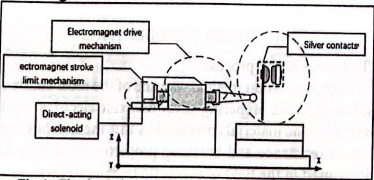
Fig.1.The simulation electrical properties tester of new model
All above testing data including contact voltage,contact current and dynamic force are acquired by the commercial DAQ system (PCI1706, Advantech, Taiwan), which has a measurement resolution of 16 bits and a sampling frequency of 250kHz. The instrument is interfaced to a personal computer using serial port RS232. Data acquisition and logging process are controlled by a PC with the help of LabVIEW software specifically programmed for this purpose.
TABLE Ⅱ
SIMULATED ELECTRICAL PERFORMANCE TEST CONDITIONS
| Category |
AC voltage |
AC current |
On off frequency |
Load category |
Remarks |
| Simulated electrical Performance test |
250VAC |
25A |
1s,on 1s,off |
Resistive load |
| Relay test |
100A |
5s,on 9s,off |
|
2. Test Results and Discussions
First, the mechanical and physical properties of the conventional material and the improved material were compared. The specific data were shown in Table 3. It could be seen that the hardness and tensile strength of the improved material were improved, but the elongation was lower than that of the traditional material.
After the improvement, the hardness of the material was increased by about 10HV, the tensile strength was increased by about 15MPa, the elongation was reduced by 9%, and the resistivity was 0.04μΩ.cm higher than that of the traditional material.
TABLE Ⅲ COMPARISONON MECHANICALAND PHYSICAL PRO-PERTIES
| Category |
Tensile stength (MPa) |
Elongztong(%) |
Electrical resistivity (μΩ.cm) |
Density (g/cm3) |
Hardness value (HV0.3) |
| Common materials |
300 |
19 |
22 |
9.77 |
85.6 |
86.7 |
86.2 |
| Improved material |
315 |
10 |
2.24 |
9.77 |
952 |
98.4 |
973 |
Fig 2 shows a comparison of the microstructures of conventional and special materials. It could be seen that the oxide particle size of the traditional material was relatively coarse, and most of the particles were above 1μm, while the oxide particle size of the improved material in this study was relatively fine, and most of the particles were below 1μm in size. According to the existing research on materials science, adding a second phase component to the metal could strengthen the metal. In this study, the oxide particle size of the conventional material was larger, while the particle size of the modified material was smaller, and most of the particle size was below 1μm. According to the principle of dispersion strengthening, the fine particles would increase the hardness, tensile strength and other properties of materials. Therefore, the hardness and tensile strength of the materials prepared in this study were higher than those of conventional materials, but their elongation was lower than conventional materials.
The electrical properties of the two materials were compared in Tables 4 and 5. It could be seen that the 95% confidence interval of Weibull curve, the electric life of simulated electrical life of conventional materials and special materials were 56,003 and 118,161 times respectively. The average electrical life of the improved material was about 62,158 times higher than that of conventional material. It could be seen from Table 5 that the relay test results of the traditional material and the improved material were 3664 times and 11,204 times respectively. The electrical life of the improved material was about 7540 times higher than that of conventional material. It could be seen from the above data that the simulated electrical performance of the improved material and the actual electrical life of the relay were better than that of those of the traditional material. The two materials showed the same electrical life law on the simulated test machine as the actual relay test. Therefore, the differences between the two materials could be studied in detail with data from simulated electrical performance tests.
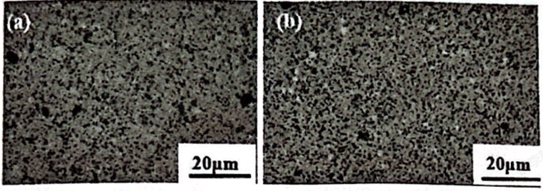
Fig.2. Comparison on microstructure between conventional materials and special materials (SEM)
a) Common materials 2000x ; b) Improved material 2000x
TABLEIV COMPARISON ON SIMULATED ELECTRICALLIFE RESULTS
| Category |
Simulated electric life(Operations) |
| Data 1 |
Data 2 |
Data 3 |
Data 4 |
Data 5 |
ρ0.95 |
| Common materials |
54698 |
52368 |
49586 |
55412 |
48769 |
56003 |
| Improved material |
99858 |
117846 |
102569 |
102546
|
112305
|
118161
|
TABLEV COMPARISON ON ELECTRICAL LIFE RESULTS OF RELAY
| Category |
Simulated electric life(Operations) |
| Data 1 |
Data 2 |
Data 3 |
Data 4 |
Data 5 |
ρ0.95 |
| Common materials |
2356 |
3541 |
2569 |
3358 |
3205 |
3664 |
| Improved material |
10254 |
11025 |
10896 |
11125
|
10457
|
11204
|
In order to further understand the reasons for the difference in electrical performance between conventional and improved materials in simulated electrical properties and relay tests, and to gain a more complete understanding of the characteristics of arcing. In this paper, traditional materials and improved materials with simulated electrical lifetimes of 55,412 and 102,546 times were selected, and the arc energy, arc time, welding force, and burn-out contact morphology were compared and studied.
Fig 3 shows the comparison of the arc energy, arc time and welding force of the traditional material and the improved material in the simulated electrical performance test. It could be seen from the figure that under the same current level, the arc energy of the improved material was 3050.59mJ within the 95% confidence interval, and the arc energy of the traditional material was 2950mJ. The arcing time of the improved material was 8.801ms within the 95% confidence interval, and the traditional material was 8.764ms. The difference was very obvious in the welding force within the 95% confidence interval. The welding force of the improved material was 0.015N, and the traditional material was 0.124N. This is due to the higher hardness of the improved material, which effectively improves the welding performance of the contacts when they were in contact.
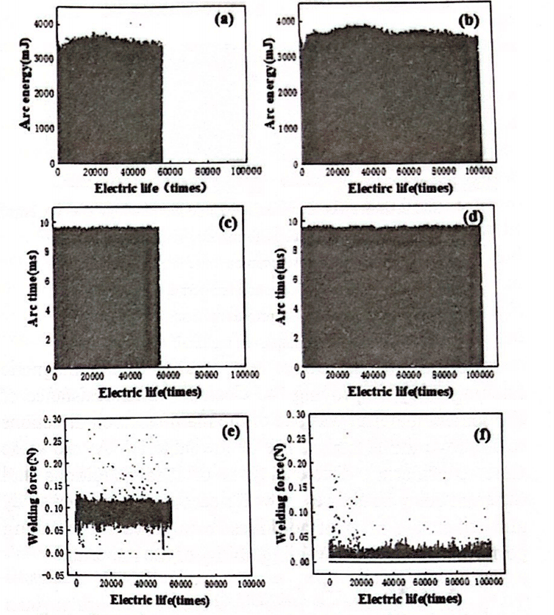
Fig.3. Comparison on arc energy and arc time, welding force between common materials and improved materials in electrical performance simulated test.
(a)arc energy of common materials; (b)arc energy of improved materials;
(c)arc time of common materials; (d)arc time of improved materials;
(e)welding force of common materials; (d)welding force of improved materials.
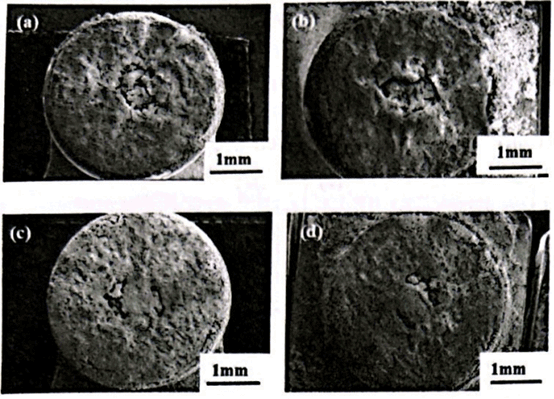
Fig 4 shows the surface morphology of the contact after arc burn in the simulated electrical performance test. As could be seen from Figure 4, the contact surface prepared by the traditional material has very serious ablation marks. At the same time, a large area of collapse occurs at the edge of the contact, which affects the electrical life of the contact.
In conclusion, the electrical life of the improved material was better than that of the traditional material. Due to its low hardness, the contacts made of traditional materials have worse wear resistance than that of the improved materials during the service process with the repeated action of a large current, so a large area of potholes appear in the middle of the working surface. The material at the contact part has been consumed, and a large number of collapses have occurred at the edge, which affects the overall structure of the rivet contact, reduces the breaking ability of the contact, and causes the final bond failure.
Fig.4.Comparison on contact surface macro morph-ology after arc burning during electrical
performance simulated test.
(a)moving contact of common material,55412 failure; (b)static contact of common
1material,55412 failure;
(c)moving contact of improved material,102546 failure; (d)static contact of improved
material,102546 failure;
According to the above test results, in the magnetic latching relay, improving the electrical wear resistance of the contact material was one of the main research directions to improve the electrical life of the material. At the same time, considering different types of load conditions and different relay structures, it was necessary to further study and adjust the ratio of additives to improve the breaking performance and anti-welding ability of the material.
Ⅲ. CONCLUSION
Based on the results and discussions presented above, the conclusions were obtained as below:
- Compared with the traditional material, the improved material has higher hardness, higher tensile strength, lower elongation and higher resistivity.
- The 95% confidence interval of the Weibull curve shows that the simulated electrical lifetimes of the traditional material and the improved material were 56003 times and 118161 times, respectively.
- The failure of traditional materials was due to the poor electrical wear resistance caused by the lower hardness of the contacts, and a large area of ablation pits appear in the middle of the working surface under the repeated action of high current. Part of the contact material had been consumed, and a large number of collapses had occurred at the edge of the contact, which affected the overall structure of the rivet contact and reduced the breaking ability of the contact. However, due to its better electrical wear resistance, the improved material could reach a higher lifetime before failure occurs.
- The higher hardness of the improved material could improve the electrical wear resistance of the contact and reduce the material loss on the contact surface under high current. At the same time, the presence of high additive content improved the anti-fusion welding ability of the material effectively. Therefore, it exhibited more excellent electrical performance under the condition of simulated electrical life.