Electrical contacts undertake the tasks of on and off and transmitting current in electrical and electronic devices, and are the main executing components of on/off of electrical switches. Therefore, electrical contacts are called "heart components”.
The contact resistance of
contact rivets is an important parameter for measuring rivet performance. One of the main criteria for the failure of electrical contacts is that the contact resistance exceeds a certain specified value. The main factors affecting the contact resistance of contact rivets include the roughness of the rivet working surface, foreign objects on the working surface, and copper adhesion on the working surface. These influencing factors are closely related to the polishing process of post-processing. The article studied the effects of two polishing processes on the contact resistance of flat and spherical electrical contacts during production and discussed the relationship between the two polishing processes and contact resistance.
Appearance Analysis
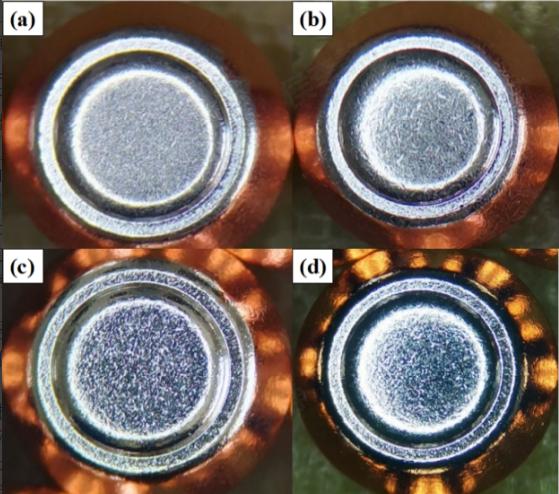
As shown in Figure 1, observed with an optical microscope, is the appearance of flat and spherical contact rivets using two polishing processes. The appearance of rivets polished by ball milling presents a matte surface, while rivets polished by steel needles present a rough surface but with a slightly brighter color.
【Figure 1. (a) ball milling and polishing surface F1; (b) ball milling and polishing surface R1; (c) steel needles polishing surface F2; (d) steel needles polishing surface R2】
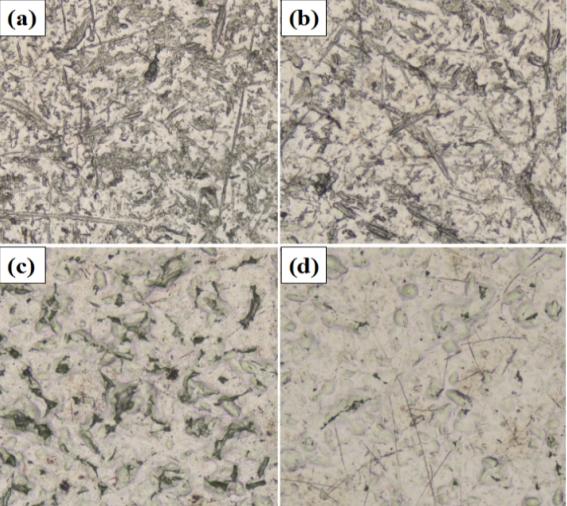
As shown in Figure 2, observed with Keyence 400X, is the contact appearance using two polishing processes. From (a) and (b), the surface polished by ball milling has no obvious copper powder or foreign objects, while (c) and (d) have a small amount of copper powder residue after polishing with steel needles. Comparing the appearance, the ball milling polishing process has a smoother surface. From (a) and (c), steel needle polishing has a significant impact on the appearance of flat and spherical rivets, but the flat rivet has more dents and a rougher surface.
【Figure 2. (a) ball milling and polishing surface F1; (b) ball milling and polishing surface R1; (c) steel needles polishing surface F2; (d) steel needles polished surface R2】
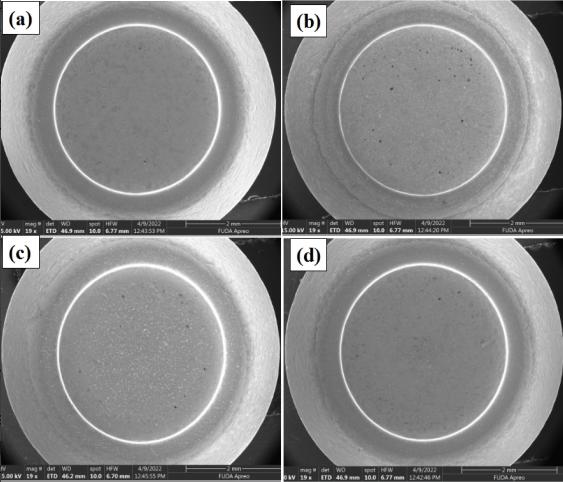
As shown in Figure 3, comparing foreign objects scanned by SEM on samples using two polishing processes, the appearance after the two polishing processes is similar, with no obvious foreign objects and similar polishing effects.
【Figure 3. (a) Ball milling and polishing surface F1; (b) ball milling and polishing surface R1; (c) Steel needles polishing surface F2; (d) Steel needles polishing surface R2】
From macro to micro, observe the appearance of the working surface of flat and spherical rivets of the two polishing processes: macroscopically, the working surface under ball milling polishing process is flatter than that of steel needles polishing, and the influence of steel needles polishing on the appearance of flat rivets is greater than that of spherical rivets, and it’s rougher.
Roughness Analysis
Table 1: Roughness of four batches of samples
| Serial number |
Ra(μm) |
| F1 |
R1 |
F2 |
R2 |
| 1 |
0.283 |
0.332 |
0.596 |
0.381 |
| 2 |
0.236 |
0.246 |
0.508 |
0.448 |
| 3 |
0.188 |
0.295 |
0.525 |
0.354 |
| 4 |
0.215 |
0.483 |
0.474 |
0.370 |
| 5 |
0.182 |
0.376 |
0.57 |
0.326 |
| 6 |
0.209 |
0.352 |
0.543 |
0.352 |
| 7 |
0.235 |
0.335 |
0.510 |
0.389 |
| 8 |
0.241 |
0.301 |
0.539 |
0.391 |
| 9 |
0.198 |
0.369 |
0.528 |
0.367 |
| 10 |
0.221 |
0.341 |
0.541 |
0.372 |
| MAX |
0.283 |
0.483 |
0.596 |
0.448 |
| MIN |
0.182 |
0.246 |
0.474 |
0.326 |
| ARG |
0.221 |
0.343 |
0.539 |
0.377 |
From Table 1, measuring 10 rivets for each process. The roughness of rivets using F2 steel needles polishing process is significantly higher than that using F1 ball milling polishing process, and the roughness of rivets using R2 steel needles polishing process is slightly higher than that using R1 ball milling polishing process, indicating that the two polishing processes have a relatively small impact on the roughness of spherical AgSnO2 rivets.
Contact Resistance Analysis
The contact resistance test results of the four batches of samples are shown in Table 2:
Table 2: Contact resistances of 4 sample batches
| Serial number |
Contact resistance mΩ |
| F1 |
R1 |
F2 |
R2 |
| 1 |
0.29 |
0.28 |
0.62 |
0.48 |
| 2 |
0.35 |
0.29 |
0.59 |
0.47 |
| 3 |
0.37 |
0.34 |
0.60 |
0.43 |
| 4 |
0.36 |
0.33 |
0.81 |
0.43 |
| 5 |
0.32 |
0.26 |
0.69 |
0.50 |
| 6 |
0.33 |
0.25 |
0.65 |
0.47 |
| 7 |
0.40 |
0.30 |
0.65 |
0.47 |
| 8 |
0.31 |
0.28 |
0.80 |
0.37 |
| 9 |
0.30 |
0.25 |
0.81 |
0.63 |
| 10 |
0.36 |
0.28 |
0.61 |
0.58 |
| MAX |
0.40 |
0.34 |
0.81 |
0.63 |
| MIN |
0.29 |
0.25 |
0.59 |
0.37 |
| ARG |
0.34 |
0.29 |
0.69 |
0.49 |
From the average values in Table 2, it can be seen that the contact resistance of rivets using the F2 steel needles polishing process is significantly higher than that using the F1 ball milling polishing process, indicating that these two polishing processes have a great impact on the contact resistance of flat AgNi rivets. The contact resistance of rivets using the R2 steel needles polishing process is slightly higher than that using the R1 ball milling polishing process, indicating that these two polishing processes have little effect on the contact resistance of spherical AgSnO2 rivets. The contact resistance of R1 ball milling polishing spherical rivets is the lowest, with an average value of 0.29mΩ and a maximum value of 0.34mΩ. The contact resistance of F2 steel needles polishing flat rivets is the highest, with an average value of 0.69mΩ and a maximum value of 0.81mΩ.
Results and Discussion
There are two polishing processes: steel needle polishing and ball milling polishing. 1. The rivets polished by ball milling polishing have a matte color, while those polished by steel needles polishing have a brighter color but with a rough surface; 2. Removing surface foreign objects from both processes is relatively clean; 3. The roughness of the ball milling polishing process for spherical and flat rivets of both materials is lower than that of the steel needles polishing process, but the polishing process has a relatively small effect on the roughness of spherical AgSnO2 rivets and a greater effect on the roughness of flat AgNi rivets; The contact resistance between the ball milling polishing process of spherical and flat rivets of both materials is better than that of steel needles polishing, but the polishing process has a smaller impact on the contact resistance of spherical AgSnO2 rivets and a greater impact on the contact resistance of flat AgNi rivets. This is mainly related to the influence of the polishing process on surface roughness and electrical contact area.