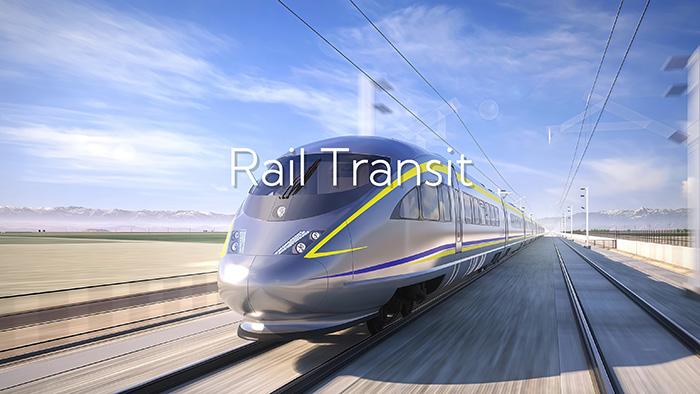
To make that happen, a train depends on a large number of electrical systems working smoothly in the background. Power must be delivered, circuits must open and close, and signals must be sent and received—thousands of times, every day. When any one of these connections becomes unstable, small issues can quickly turn into delays, maintenance headaches, or safety risks.
That's why
electrical contact materials matter. They are the tiny "touch points" that let electricity switch on and off and allow control signals to pass reliably. Although small, their performance and durability play a key role in keeping rail systems stable—especially as the industry pushes toward higher speed, higher traffic density, and smarter operation.
Key Challenges for Electrical Contacts in Modern Rail Systems
As train services become more frequent and operating conditions more demanding, electrical contacts are being pushed harder than ever. Today, the industry is facing three practical challenges.
- High-current switching wear — Frequent start–stop cycles and repeated current interruption create high current surges and electrical arcing at the contact surface. Over time, this can increase contact resistance, cause unexpected heat buildup, reduce energy efficiency, and shorten component life.
- Harsh-environment degradation — Humid tunnels, coastal salt spray, dust and pollution, and large day–night temperature swings can accelerate oxidation, corrosion, and surface contamination—making it harder to maintain stable connections in the long run.
- Lifecycle cost pressure — When key contacts fail early, the impact goes far beyond a small part replacement. It can trigger unplanned maintenance, service interruptions, higher labor and spare-part costs—and in some cases, increased safety risk.
These realities are exposing the limits of conventional contact materials. Choosing the right electrical contact material is no longer just a routine purchasing decision; it is a reliability decision that affects safety, uptime, and total cost of ownership. That is why the
rail industry is actively looking for more robust, longer-lasting material solutions.
Fudar Alloy: Advanced Electrical Contact Material Solutions
Fudar Alloy specializes in electrical contact materials and precision contact components. Backed by deep materials expertise and robust process engineering, we provide one-stop support for rail transit electrical applications—from material selection and formulation to precision part manufacturing. We believe long-term reliability is built on disciplined control of details.
Weld-Resistant Contact Material for Miniature Circuit Breakers (MCBs) — AgWC
In miniature circuit breakers (MCBs) used in rail auxiliary power and distribution systems, repeated interruption events expose contacts to intense arcing and high current surges. To address these challenges, Fudar Alloy produces AgWC using an advanced cladding process that promotes a more uniform and stable microstructure. With strong arc-erosion resistance and anti-weld performance, AgWC helps contacts maintain low, stable contact resistance and a controlled temperature rise—supporting longer electrical life and more reliable interruption performance for MCBs.
High-Reliability Fusible Element Strip for Industrial Fuses — BAg72Cu
In industrial fuses used in rail DC traction, charging systems, and other critical circuits, the fusible element must operate fast and predictably under fault conditions to enable selective coordination—clearing the fault while minimizing the impact on the rest of the system. Our BAg72Cu fusible strip is produced via vacuum melting, delivering tight thickness tolerance and stable electrical resistance. It also offers good mechanical strength and formability, supporting consistent manufacturing and reliable fuse performance. Compared with pure silver elements, BAg72Cu provides a more cost-efficient option while maintaining precise protection behavior.
Arc-Resistant Contact Materials for AC Contactors and Signal Relays — FAg / AgNi10
In AC contactors and relays, higher bulk resistivity can increase losses, leading to excess heat—especially under frequent switching. To help address this, Fudar Alloy offers FAg and AgNi10 as eco-conscious contact material options. Through optimized Ag content and a powder-metallurgy processing route, we reduce bulk resistivity by ~0.2 μΩ·cm (typical, depending on composition and processing) compared with conventional materials. The result is a lower contact temperature rise, improved operational stability, and reduced risk of unplanned maintenance and service interruption.
RoHS-Compliant AgSnO₂ Sheet Material for AC Contactors — AgSnO₂
For frequently operated AC contactors in power control systems, we provide AgSnO₂ materials produced through powder pre-oxidation and silver-cladding extrusion process. This material forms a fine, uniformly distributed dispersed phase within the silver matrix and delivers strong interfacial bonding, helping the material withstand repeated arcing with reduced risk of severe spatter or pitting. As a result, AgSnO₂ maintains stable contact resistance with minimal fluctuation and offers strong anti-weld performance under high arc stress. In addition, AgSnO₂ is a cadmium-free, RoHS-compliant option—well-suited for customers seeking both high reliability and greener material selection.
Customized integration: Complete delivery from materials to components
Building on the material solutions above, Fudar Alloy also offers customized, integrated
component services. Based on your product structure, electrical requirements, and manufacturing process, we provide application-specific design and development—turning high-performance contact materials into ready-to-install, standardized components. This component-based supply model can simplify supply chain and production assembly, reduce quality risks introduced during secondary processing, and help keep electrical connection performance consistent over the product lifecycle—enabling a truly reliable, one-stop delivery from materials to components.
Conclusion
As rail transit moves toward a future that is safer, more efficient, and more intelligent, electrical contact materials remain a small but indispensable part of the power system, and their reliability is fundamental to stable system operation.
Founded in 1994, Fudar Alloy has stayed focused on the R&D and manufacturing of electrical contact materials, delivering advanced contact solutions for electrical systems worldwide. Driven by continuous innovation and rigorous quality standards, we work to build reliability into every contact point. Looking ahead, we will keep partnering with customers and industry stakeholders to support the ongoing evolution of global rail transit—helping every journey run safely, smoothly, and on time.
If you're evaluating contact materials or components for rail applications, contact us to discuss your design requirements and operating conditions.