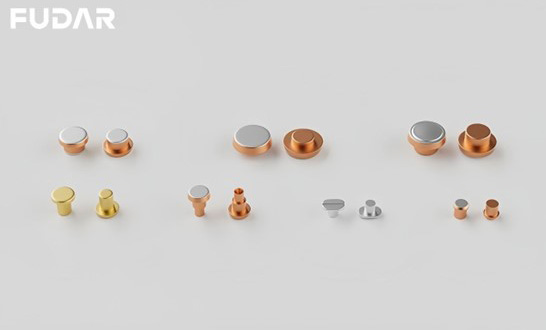
As applications continue to demand smarter control, higher energy efficiency, and longer service life, extending the electrical service life of AC contactors has become a key engineering focus. At the center of this challenge are the contacts—the critical elements responsible for current carrying, arc interruption, and electrical isolation. Their material performance directly impacts reliability, maintenance intervals, and overall equipment lifetime.
Industry estimates suggest that approximately a quarter of global annual silver consumption is used in
electrical contact materials, making silver-based systems the mainstream choice. This article focuses on three of the most widely adopted silver- based contact systems—AgNi (silver–nickel), AgMeO (silver–metal oxide), and AgCuO (silver–copper oxide)—and analyzes their characteristics, typical applications, and future development trends.
1. Performance of Mainstream Contact Material Systems
AgNi
Advantages
- Low electrical resistivity and high conductivity
- Low contact resistance; favorable arc transfer behavior during switching
Limitations
- Relatively low hardness and limited resistance to contact welding, especially under higher currents
- Typically used in AC contactors rated below 25 A (application-dependent)
AgMeO Family
- AgCdO: Widely used in Chinese markets due to strong anti-welding performance and low contact resistance. However, because cadmium is toxic, AgCdO is increasingly being phased out in favor of environmentally compliant alternatives.
- AgSnO₂: A common eco-friendly alternative to AgCdO. It offers high hardness and strong resistance to arc erosion and contact welding, but typically shows higher contact resistance and faster temperature rise.
- AgSnO₂In₂O₃: By adding indium oxide (In₂O₃) to AgSnO₂, resistance to arc erosion, contact welding, and material transfer can be further improved— often with a trade-off of increased contact resistance.
- AgZnO: Often demonstrates better resistance to contact welding and arc erosion than AgCdO while maintaining low contact resistance. However, due to limited research, it is used less frequently at present.
AgCuO
AgCuO is commonly produced via pre-oxidation routes and powder metallurgy.
Advantages
- Good conductivity
- Uniform dispersion of CuO particles, contributing to excellent resistance to contact welding and arc erosion
Limitations
- Powder-metallurgy AgCuO may exhibit higher porosity, which can negatively impact electrical life.
Other Materials
- Fine-grained silver alloys: Produced by adding small amounts of alloying elements to refine grain size, improving strength, resistance to contact welding, and electrical wear while maintaining high conductivity. At present, they are typically used in low-current AC contactors.
- Ag–RE (Silver–Rare Earth):
- Rare-earth reinforced silver alloys can enhance anti-welding and arc-erosion resistance via solid-solution strengthening and grain refinement.
- Rare-earth oxide-reinforced silver alloys can improve overall electrical performance through finely dispersed oxide particles.
- Excessive rare-earth additions may increase contact resistance, and the underlying mechanisms still require further study.
2. Key Tests and Findings
Rigorous laboratory testing provides an objective way to validate material performance. The results below are presented for reference and highlight several practical trends observed during evaluation.
Simulated endurance testing indicates that AgNi with 15% Ni delivers the best overall balance, completing 100,000 enhanced-duty cycles in the test setup. When the Ni content increased to 17–20%, contact cracking was observed more frequently, which in turn increased the risk of contact welding. For AC contactors rated at 25 A, an AgNi contact composition near 15% Ni is therefore recommended (subject to design and duty conditions).
Adding SnO₂ into AgCdO can improve the dispersion of CdO and enhance manufacturability. The optimized material successfully met temperature-rise and electrical-life test requirements, offering a practical route to replace certain high- cadmium AgCdO formulations.
By adding high-hardness WO₃ and MoO₃, AgSnO₂ showed improved arc interruption behavior and high-current breaking capability, while the weld force decreased. The modified formulations passed temperature-rise and electrical-life testing, achieving up to 1,000,000 electrical switching cycles under severe test conditions.
AgCuO demonstrated strong mechanical and electrical stability in demanding tests, completing 2,000,000 mechanical cycles and passing a 1500 A high-current temperature-rise test. Under both resistive and inductive loads, the arc extinguishing time remained short and stable—performance attributed in part to the uniform dispersion of CuO particles within the microstructure.
3. Material Selection Guidelines
Results across multiple comparative evaluations indicate that contact material performance is highly application-dependent. The following guidance can serve as a practical reference for material selection:
- Low-current duty (<100 A): AgNi materials are often preferred. In the evaluated conditions, they showed strong resistance to cracking and stable molten behavior during switching, delivering better electrical life and contact- welding resistance than AgCdO.
- High-current duty (>100 A): AgSnO₂ materials are recommended. With higher thermal stability and the protective role of wetting-promoting additives, they can reduce material spatter and improve both contact-welding resistance and electrical life compared with AgCdO. As a result, AgSnO₂ is widely viewed as a key development direction for high-current molded-case (frame- type) AC contactors.
- Conventional AgCdO: While AgCdO may still offer advantages in certain duty cycles, it carries cracking risk in some conditions and faces increasing environmental constraints, which will likely limit future adoption.
- AgZnO and AgC: These materials are generally more suitable for specific asymmetric duty or specialized operating conditions and tend to be less universal for broad applications.
Ultimately, scientific material selection should start with the actual current rating and switching duty conditions (load type, switching frequency, temperature rise limits, and required electrical life), ensuring the chosen material can deliver its full performance potential in the real application.
4. Other Reliability Factors
Beyond the contact material itself, volatilized contaminants from surrounding components can also impact contact reliability in real operating environments. For example:
- Phosphorus-containing volatiles released from certain plastic parts can deposit on contact surfaces, increasing contact resistance and accelerating early-life failures.
- Paraffinic compounds from enameled-wire lubricants can volatilize easily and may degrade the performance of auxiliary contacts.
Overall, practical design and material selection should evaluate not only the contact alloy system, but also the compatibility of nearby components to minimize reliability risks.
5. Future Development Trends
Going forward, R&D in electrical contact materials is expected to continue focusing on:
Improving contact-welding resistance, arc-erosion resistance, and long-term stability of contact resistance.
- Environmental compliance and safety
Accelerating the adoption of cadmium-free and other environmentally compliant material systems.
Optimizing processing routes to reduce defects and variability, improving batch-to-batch consistency, and extending service life.
- Next-generation materials
Advancing research into fine-grained, nanostructured, and rare-earth–reinforced composite systems—particularly silver-efficient formulations that maintain high performance with lower silver usage.
Conclusion
Contact materials may be small, but they play a decisive role in ensuring long-term equipment reliability. As expectations continue to rise for both performance and environmental compliance, Fudar Alloy remains dedicated to developing and manufacturing high-performance electrical contact materials. Through ongoing material innovation and application-focused technical support, we help customers across the low-voltage electrical industry build solutions that are more efficient, safer, and more sustainable.
For application support or material recommendations, feel free to
contact our team.