Ⅰ. INTRODUCTION
Electrical contact often occurs in household appliances, power systems, aerospace and other equipment, which was mainly divided into the following three categories: fixed electrical contact that transmits electrical signals by means of two fixed contacts, such as electrical connectors; Sliding electrical contact that transmits electrical signals by sliding contact of two contacts, such as electric brush and roller contact; The separable electrical contact, such as the contact of various switching appliances, was realized by making and breaking two contacts to make and break the circuit.
Some physical phenomena often occur, especially in the process of separable electrical contact, such as the increase of contact resistance, were eroded on the contact surface, fusion welding, wear, material transfer, etc. With the development of social science and technology and application, higher requirements were put forward for the relevant performance of the selected electrical contact materials.
Rivet electrical contact materials have been widely used in various switch fields due to the excellent characteristics of combining silver and other additives.
Due to the complex plastic processing process of rivet like metal materials, the traditional methods can no longer meet the requirements of deep level forming stress analysis. However, the introduction of finite element can accurately simulate the material forming process and stress state. The rigid plastic finite element method was widely used in the research of plastic forming of various metals. It was based on the relationship of small strain and does not consider the elastic deformation when plastic deformation occurs. The rigid plastic finite element method was applicable to the plastic deformation process of materials with large strain during hot working and deformation. Generally, the following assumptions were made for rigid plastic materials: elastic deformation during material deformation was not considered; the volume force and inertial force of materials were not considered; the material volume remains unchanged; the material flow follows Levy Mises flow theory.
Some people used ABAQUS software to simulate the quasi- static riveting process based on the three-dimensional finite element simulation method to obtain the deformation of the rivet rod after the riveting of conical and conventional semicircle head rivets, and at the same time compared and analyzed the change of the residual stress of the plate. Finally, a grey system consisting of rivet rod deformation uniformity, rivet size and rivet head height was established. Through the calculation and analysis of the correlation degree of the system, the influence of rivet size and rivet head height on the uniformity was determined. As a result, the rivet rod uniformity after riveting with tapered rivets was better than that of conventional rivets. Others used DEFORM-3D software to study the effect of different cold heading process parameters on the formability of TC16 titanium alloy.
The results show that the maximum equivalent strain increases with the increase of friction coefficient, and first increases and then decreases with the increase of deformation velocity; the maximum equivalent stress increases with the increase of friction coefficient, and decreases first and then increases with the increase of deformation velocity; the billet temperature increases with the increase of friction coefficient or deformation speed; the cold heading load increases with the increase of friction coefficient or deformation speed, and the friction coefficient has the greatest influence on the cold heading load. The cold heading process parameters of TC16 titanium alloy bars were optimized through analysis. They compared and analyzed the influence of cold heading and hot heading processes on the microstructure of TC16 alloy.
The test shows that after solution aging, the microstructure and mechanical properties of cold heading and hot heading samples are close to each other. Qingyun Zhao analyzed the head forming process of titanium alloy hexagon head bolt through numerical simulation. DEFORM-3D finite element software was used to simulate the change of temperature field, material flow, distribution of stress field and strain field and deformation load during the forming process of hexagon bolt head, and analyzed the bolt head forming process.
Ⅱ. ESTABLISHMENT OF COLD WORKING SIMULATION MODEL
A. Establishment of 3D Finite Element Model
In order to facilitate the simulation analysis of the forming process of rivet electrical contact materials under different material properties (elongation, elastic modulus, hardness), the model was simplified in this paper, and only the upper and lower molds and workpieces during forming were retained.
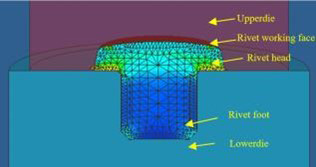
Based on the three-dimensional Software Solidworks, a three-dimensional cold forming model of rivets was established, and simple assembly was carried out according to the actual forming position. After assembly, the model was converted into an intermediate format and imported into the finite element software. The simulation result model was shown in Fig 1.
Fig 1. Simplified cold forming model
TABLE I: MECHANICAL AND PHYSICAL PROPERTIES OF WORKPIECES AND MOLDS
| Material |
H26 |
AgSnO2(15) |
| Poisson's ratio |
0.3 |
0.31 |
| Density (g/cm3) |
7.8 |
9.89 |
| Thermal conductivity(W·m-1K-1) |
24.5 |
30.6 |
| Specific heat capacity(J·Kg-1K-1) |
0.46 |
0.35 |
| Coefficient of thermal expansion (10-5K-1) |
1.1 |
1.22 |
The mold material used in the simulation is H26, the tool material of the software, and the workpiece material is AgSnO2(15). The mechanical and physical properties of the mold and workpiece were shown in Table I.
B. Numerical Simulation Process Parameter Setting
In the finite element software, hexahedral grid division was adopted for the workpiece blank. In order to ensure more accurate test results, the grid cell size was uniformly set to 0.9mm, divided into 8606 cells, and the upper and lower dies were treated as rigid bodies.
In the stage of pier rough forming, a hydraulic press was selected for simulation, and the speed was set at a constant speed of 0.1mm/s. During pier rough forming, the lower mold remains fixed, and the friction boundary condition between the tool and the mold was defined as shear friction, and the surface friction coefficient is 0.2; The defined ambient temperature was 20°, the initial temperature of the workpiece and mold was 20°, and the defined equipment and mold were released after the test.
Ⅲ. ANALYSIS OF SIMULATION RESULTS
The elongation, elastic modulus and hardness of
electrical contact materials such as rivets were numerically simulated by using numerical simulation software to study the influence of parameter changes on the medium effect force and equivalent strain of materials in cold working. Now the results were analyzed and discussed in detail.
A. Effect of Elongation on Material Forming
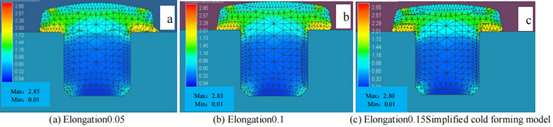
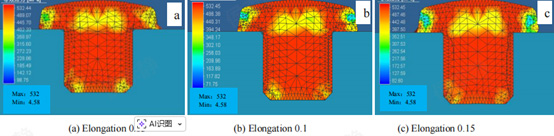
In order to analyze the influence of different elongation on the cold working and forming of materials and the distribution of equivalent stress and strain, under the same other parameters, the material elongation is set to 0.05, 0.1 and 0.15 respectively. The equivalent strain results were shown in Fig 2 and the equivalent stress results were shown in Fig 3.
Fig. 2. Equivalent strain profile of rivet forming under different elongation.
Fig. 3. Equivalent stress profile of rivet forming under different elongation.
It can be seen from Fig. 2 that the effect strain such as rivet was mainly accumulated at the contact between the rivet head and the lower die, and the distribution was extremely uneven. With the increase of elongation, there was no obvious change in the position where the effect strain such as rivet occurs and the accumulated strain, which may be due to the small change range of elongation, resulting in the inconspicuous change of material strain.
It can be seen from Fig 3 that the equivalent stress on the rivet working face and the contact with the die was the largest, and a relatively obvious parabola like X-shaped shear band was formed in the center. With the increase of elongation, the equivalent stress of the rivet X-shaped shear band gradually decreases along the center of the rivet head to the four sides, and the stress was the smallest at the left and right edges. It shows that the elongation affects the stress of the rivet when it was finally formed, and affects the regional distribution of the shear band in the rivet head, thus affecting the forming performance of the rivet. The reason is that with the increase of elongation, the deformation of the rivet head center under the influence of elongation becomes easier. At this time, the heat generated by plastic deformation increases and the deformation resistance decreases, so the equivalent stress gradually decreases.
B. Influence of Elastic Modulus on Material Forming
In general, in industrial applications, the elastic modulus was assumed to be a fixed value, ignoring the impact of the elastic modulus on the material. However, for some metal materials with obvious spring back phenomenon, it seriously affects the optimization design of forming process and the accurate control of forming size. Therefore, it was necessary to clarify the influence law of elastic modulus on rivet forming in material forming analysis.
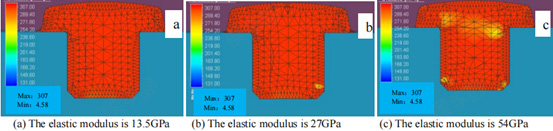
In the simulation, other parameters remain unchanged, and the elastic modulus of the material was set to 13.5GPa, 27GPa and 54GPa respectively. The equivalent strain results were shown in Fig 4. It can be seen from Fig 4 that the equivalent strain of rivets mainly accumulates at the contact position between the nail head and the rivet lower die. With the increase of the elastic modulus, the accumulated amount of equivalent strain does not change significantly, which indicates that the elastic modulus has little effect on the equivalent strain in material molding within this range.
The equivalent force results were shown in Fig 5. It can be seen from Fig 5 that, under the same force, the cross-sectional stress of the rivet decreases with the increase of the elastic modulus. It may be that the temperature of the material increases with the increase of the elastic modulus. According to the theory of atomic vibration in solids, the atomic vibration deviates from the equilibrium position and the displacement increases with the increase of temperature. At this time, the atomic spacing increases and the binding force between atoms weakens, resulting in the decrease of the system energy. According to the formula of bulk elastic modulus, the energy decreases and the elastic modulus also decreases. When the elastic modulus is 54GPa, the equivalent stress at the part of the rivet section decreases most, about 30MPa, but from the perspective of the overall forming of the rivet, this has little impact on its forming effect.
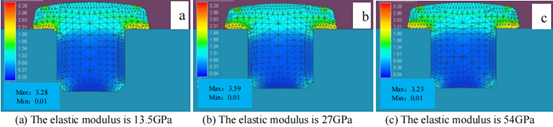
Fig 4. Equivalent strain profile of rivet forming under different elastic modulus.
Fig 5. Equivalent strain profile of rivet forming under different elastic modulus.
C. Effect of Hardness on Material Forming
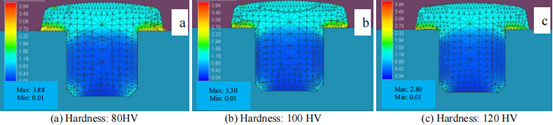
According to the established model, the material hardness was set to 80HV, 100HV and 120HV with other parameters unchanged. The equivalent strain results of material forming under different hardness were shown in Fig 6.
As can be seen from Fig 6, with the increase of hardness, the accumulation of equivalent effects at the contact between the rivet head and the lower die gradually decreases. Equal- effect deformation usually reflects the deformation degree of the material. From the perspective of forming a single rivet, the rivet head was affected by the shear force to generate metal flow along the surface of the lower die. With the increase of the contact surface with the lower die, it will be subject to the joint action of the shear force and the extrusion force at this place, so that the accumulated equivalent strain at this place was larger than that in other areas; From the forming of rivets with different hardness, the increase of hardness hinders the fluidity of materials, so the accumulation of equivalent strain decreases with the increase of hardness.
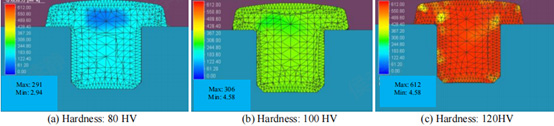
The equivalent stress results of material forming were shown in Fig 7. It can be seen from Fig 7 that when the material hardness was 80HV, 100HV and 120HV, the corresponding equivalent stress was 153MPa, 306MPa and 612MPa respectively. The stress of the rivet was mainly concentrated at the connection between the rivet head and the die, and the stress at the center is small. With the increase of hardness, the stress value of rivet during forming gradually increases, and the stress distribution is uneven.
Fig 6. Hardness equivalent strain profile of different materials.
Fig 7. Hardness equivalent stress profile of different material.
The reason is that the hardness of the material has a great impact on its processing performance, and the material flows due to stress deformation, which weakens the directionality of the raw material structure. With the increase of deformation, it becomes more difficult to deform the material. At this time, the heat generated by plastic deformation decreases, the deformation resistance increases, and the equivalent stress gradually increases, resulting in a large range of obvious stress concentration at the connection between the edge of the rivet working face and the upper die. However, the uneven distribution of equal effect force was easy to cause defects such as cracks in the upsetting process of rivets, which was more consistent with the cracking situation and position of rivets in actual production.
Ⅳ. CONCLUSION
As the increase of elongation, there was no obvious change in the position of rivet equivalent strain and strain accumulation, and the equivalent stress decreases as the increase of elongation.
When the elastic modulus was in the range of 13.5GPa-54GPa, with the increase of the elastic modulus, the equivalent strain distribution in each area of the material does not change significantly, and the equivalent stress decreases, but the effect on the overall rivet forming is small.
The equivalent stress of rivet working face increases with the increase of material hardness, and the probability of cracks on the surface increases gradually, which was closed to the cracking of rivets in actual production.
In order to improve the forming quality of rivet products, we suggest to design materials from the direction of high elongation, high elastic modulus and low hardness.