It is that can induce the generation of short-circuit fault, contact welding, or fire, etc, because of contact resistance and contact temperature rise in engineering applications. At present, the research on the contact resistance of
electrical contact material is mainly divided into 2 main directions. One is theoretical research that is studied by some mathematical models or formulas. Such as blocking the permanent state introduced the circular, elliptical, circular, square, and rectangular contact resistance formula, Senchang Chen reported the latest contact resistance model, G-W model, etc.; Another is test equipment research. Contact resistance data is obtained by manufacturing test equipment, such as an Automatic measuring system for contact resistance of new contact material made by Wanbing Reng. His theory can be used to test the 20 contacts when the contact resistance is tested with a resolution of 0.1M. The ICT detection system applies to test 1-30A power relay contact resistance made by Zhi Chen. As is known to all, the contact resistance is composed of 2 parts, which are contraction resistance and film resistance. Many factors affect the contact resistance in practical applications, including material properties, roughness, contact form, air suspension, etc. Therefore, this paper focuses on the analysis of the influence factors of contact resistance of electrical contact materials. It will introduce some methods to reduce the contact resistance of electrical contacts for electrical contact materials and the entire low-voltage electrical industry development to provide technical support.
Ⅰ. INFLUENCING FACTORS ANALYSIS
Many of the factors for the contact resistance are affected by the reason for the contact resistance. It mainly has the after-treatment process, contact properties, contact pressure, contact state, contact pollution, contact temperature rise, environmental factors, etc. The following will analyze factors one by one.
A. After treatment process
The surface condition of the contact product is mainly decided by the post-processing technology of the contact. It directly affects the roughness and cleanliness of the contact surface, that the proper or not of the post-treatment process. And then affect the size and stability of the contact resistance. That is why the size and number of conductive spots on the overly rough contact surfaces are small. The ideal contact surface should have the appropriate roughness, so that it is possible to obtain a low and stable contact resistance. At the same time, the smaller the roughness of the contact surface, the more effective area in reducing the harmful gas and physical particles. At the same time, the smaller the roughness of the contact surface, the more effective area to reduce the harmful gas and physical particles, and also reduce the formation of oxide film, curing film, and the chance of environmental pollution. The cleanliness of the contact surface is the number of foreign impurities adsorbed on the surface of the contact. The impurity of the contact surface will have a bad influence on the contact resistance, which is one of the main reasons that lead to the instability of the electrical life of the contact. Jingxian Xiong listed in Table 1 by 4 kinds of post-processing processes of rivet samples, with "CRM-2 contact resistance type contact resistance tester to measure each sample. Test conditions are: test voltage 6V AC, test current 100mA, contact pressure 0.15N, the average value of the contact resistance of the 4 sets of samples is 1.22m, 2.05m, 1.50m, 0.74m. Jingxian Xiong believed that the test results of the first groups showed that the contact surface status of the contact surface is not stable due to the inevitable adsorption of some impurities in the process of production. And the adsorption of harmful substances in the production process is still left on the contact surface, without removal, which will slowly erode the contact surface, so that the contact surface conditions deteriorate further, and contact resistance will continue to grow. The test results of the 2,3 group were not satisfactory, which indicated that the improper post-treatment would make the contact surface condition worse, and the introduction of new harmful impurities would accelerate the formation of the surface film, so that the contact resistance increased significantly. The test results of the fourth group of samples show that the contact surface has good roughness and cleanliness, and the contact resistance of the contact is low and stable.
TABLE 1 RIVET POST-PROCESSING TECHNOLOGY
| Number |
Quantity |
| 1 |
direct test without any processing |
| 2 |
direct heat treatment, ball milling, and polishing |
| 3 |
pretreatment before heat treatment, heat treatment |
| 4 |
pretreatment before heat treatment, heat treatment,
ball milling and polishing |
B. Contact Properties
The small current mainly uses
the precious metal material and its alloy, the high current mainly uses copper, the aluminum and its alloy, and the pure precious metal is mainly used in the coating material when the electrical contact material is classified according to the current level. The microstructure of electrical contact material directly determines the size of the contact resistance, which mainly includes the hardness of H and the resistivity of ρ. The theoretical formula of the total shrinkage resistance of conductive spots is:
(1)
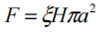
Type a in (1) is the radius of conductive spots, which can be seen that the nature of the shrinkage resistance is the metal resistance; the size of the electrical contact material resistivity is proportional to the conductivity of the spot radius is inversely proportional. In the case of plastic deformation, the relationship between the indentation area and the contact force F is:
(2)
Type ξ in (2) is constant, with a range of 0.3-1. It can be seen that the hardness of H, the larger the conductive spot radius of a smaller, the smaller the contraction resistance Rs. When the contact force F phase. Therefore, the contact properties of materials, hardness H, and resistivity have a decisive effect on contact resistance. It needs to be considered with lower hardness and resistivity, the same as considering the stability of contact materials.
C. Contact Pressure
According to the above analysis, the pressure on the unit area of the contact area is:
(3)
The R is a rigid sphere radius of curvature, and H is the depth of indentation when the rigid sphere and the plane contact.
(4)
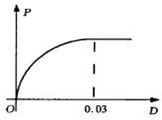
Formula (4) can be obtained P-D curve. As shown in Figure 1, you can see the beginning of a rapid rise in the curve; the contact surface is in the elastic deformation stage. Subsequently, the curve tends to be gentle, and the contact surface is in the stage of elastic-plastic deformation. After D>0.03, the P is kept as a constant, and the contact surface is presented as a stage of complete plastic deformation.
Fig. 1 P-D relationship curve
Therefore, the contact material contact resistance decreases with the increase of the contact pressure., the pressure reaches a certain value, the contact resistance basically remains unchanged. Continuing to increase the pressure will produce a larger mechanical wear. So the contact material pressure must be effective in the control of a scientific and reasonable range. For the relay, the contact pressure increases, and the electromagnetic suction is increased. It results from increasing the size of the relay, reducing the sensitivity of the relay, but also causes serious rebound when contact is made, and increases contact wear, shortening the life of the relays. So the contact pressure is not the bigger the better. It is reasonable control in a safe range after comprehensive analysis and based on the comprehensive analysis of the above factors.
D. Contact State
The electric contact material is divided into 3 types according to the contact. (1) point contact, most of which is the contact between the sphere and the plane or between the sphere and the circular arc surface. From a geometric point of view, the two sides contact at a point, but in fact, there is a small area of contact points; (2) line contact, cylinder and plane, cylindrical surface and parallel cylindrical surface contact; (3) the surface contact, the contact along the broad surface. The influence of contact state on the shrinkage resistance Rs is mainly expressed in the number of contact points. Generally speaking, the contact points of the contact points"n ”up to the minimum shrinkage resistance. Contact point ”n” at least, the shrinkage resistance should be maximum, and Line contact between the two. The effect of the contact form on the film resistance is mainly manifested in the pressure at each contact point. If the contact pressure is F, the contact point is n, then the pressure on each contact point is F1=F/n. Thus, the pressure on each contact point, F, and the contact form. It is believed that "n” contact points are point contact. The contact pressure at least F under the same conditions, the contact point of each point contact form under pressure, is the most easy to destroy the surface of the contact surface, so that the membrane resistance Rb decreases. On the contrary, the contact point of contact points "n” up to eliminate the ability to destroy the surface of the table is small, the film resistance increases, and the line contact between the two. In addition, the effect of the contact state of the contact resistance is related to the size of the contact pressure. When the contact pressure is small, small contact resistance is not necessarily better than the point contact or line contact; the data in Table 1 illustrate this point.
TABLE 2 COPPER CONTACT RESISTANCE AND CONTACT FORM,
CONTACT PRESSURE BETWEEN
| Contact form |
Contact Resistance(μΩ) |
Contact pressure
F=9.807N |
Contact pressure
F=980.7N |
| Point contact |
230 |
23 |
| Line contact |
330 |
15 |
| surface contact |
1900 |
1 |
E. Contact Pollution
Because there are many kinds of pollutants, such as dust, fiber, liquid, and so on, most of them are derived from the surrounding environment or processing technology. Pollution is an important factor that affects the contact resistance of the relay. Pollution can cause a relatively large film resistance or a serious chemical corrosion, and thus enhance the resistance of contact, which will eventually greatly reduce its life is greatly reduced. Therefore, in the work of the time, it is possible to carry out clean production to effectively reduce pollution. Zhi Chen reported that the relay contacts the 2 major sources of pollution. In the process of manufacturing, the relay is inevitably contaminated by the copper chip because of the existence of a copper base. The contact silver alloy composite layer surface copper chip is easy to oxidize to form copper oxide. It will inevitably be affected by high temperature and humidity, and other environmental factors, after the relay assembly and storage process. The contact resistance is detected in the 180-260m (6V/1A). The contact resistance of the selected contact is less than 30m (6V/1A) in the range of less than. If the contact between the contact surface of another existence of copper exists, the contact resistance of the contact will obviously increase and is not stable. (2) Instant glue volatile matter, before the test, to detect the contact resistance is less than or equal to 30m (6V/1A), Plastic glue for instant glue (modified phosphate), ambient temperature 26, a nd relay contact resistance after a period of time. When the use of instant glue reaches 280-311mg, the contact resistance is above 999m, the contact is not conductive, and the contact surface can see an obvious white foreign body. Because the modified phosphate is a kind of insulating material, a large amount of material is attached to the contact surface. It will lead to large contact resistance of the relay or even non-conducting. Its contact resistance has been reduced, but sis still more than 138m when reducing the use of instant glue (95-110 mg). It can be seen that the effect of the instant gel volatiles on the contact resistance is very large.
The harm of surface foreign bodies on the contact resistance was reported by Xiaoping Bai, which light contact resistance increases or contact failure. The main reasons for the foreign bodies on the surface of electrical contacts are (1) the surface of electrical contacts in the manufacturing process is affected by the contamination of the alloy, copper, and oil. (2) refractory materials, utensils, abrasive, abrasives, polishing agents, and lubricants for electrical contact surfaces during he heat treatment and surface treatment; (3) dust, fiber, and human skin contamination on the surface of electrical contacts during packaging and storage; (4) the assembly process is plastic and oil pollution. It often occur some phenomenon’s which as large contact resistance, temperature rise, and some even lead to the early failure of electrical contacts due to surface foreign bodies. Ten groups of experimental data show that the surface of the foreign body will increase the resistance of the contact resistance. When the surface of the foreign body, the average value of the 10 sets of data contact resistance is 5.145m, and when removed, the average value of the 10 sets of data contact resistance is 0.474m.
F. Contact Temperature rise
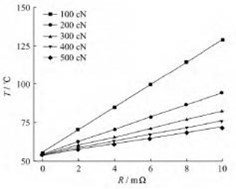
Once the temperature of the contact surface increases, the contact surface and the area will change. If the pressure of the contact does not change, the high temperature will cause the resistance to become larger, increasing contact resistance. In addition, when the temperature reaches a certain value, the contact can be softened, and the area of the contact is increased, and the resistance is decreased. Therefore, the temperature rise will have a certain effect on the stability of the contact work. WanbinRen Multiphysics COMSOL finite element software was used to establish the model of temperature measurement system in the temperature measurement system, which contains the contact pair, thermocouple, and contact clamp structure. He is based on the temperature rise of the
electric contact of the rivet is directly measured on the inner of the implanted contact. The simulation results of the temperature rise of the contact pressure and the film resistance obtained are shown in the figure. Spot steady temperature rise and contact resistance are positively correlated; the contact pressure and the increase in the current will cause a decrease in the contact resistance.
Fig. 2 Relationship between contact pressure and spot temperature rise
G. Environmental Factors
In the dry atmosphere, most of the electrical contact material surface is dry corrosion, and the general performance of the oxidation of the material, curing, and so on. But in the damp atmosphere, surface water adsorption in the air will form a layer of film on the surface of the water, impurities in the water layer, and adsorption of air dust, the formation of the electrolyte, the material corrosion from chemical corrosion to electrochemical corrosion, thereby accelerating the corrosion rate. China's environmental pollution is very serious, caused by environmental factors, and the contact fault accounted for a large part. In most cases, the contact points are exposed to the atmosphere, corrosive gases in the air, dust, and organic gases will produce an insulating foreign matter in the contact interface. For example, the Automotive electrical work environment is relatively poor; in the current automotive electrical failures, most of which are caused by poor contact. Ambient temperature rise leads to thermal stress on the contact reliability is also very large. Near the temperature increase will accelerate the diffusion and migration of impurities in the metal matrix., In addition, the temperature rise will accelerate the stress relaxation, direct damage to the mechanical properties of the connector, and thus accelerate the corrosion, the surface of the formation of an insulating corrosion film. Thermal stress, especially the relative motion of a regular wave, causes fretting corrosion. These eventually caused the occurrence of contact failure. Tonghui Li uses SO2 corrosion gas to corrosion of 3 kinds of contact materials. The conductivity changes with the corrosion film thickness as shown in Figure 3. As can be seen, the film thickness is less than 200nm, the conductivity of the material with the increase of film thickness into a linear decrease, but the change is not very obvious. This is due to the corrosion not being very serious at this time, and the formation of a non-uniform distribution of the metal surface of the island. In the conductivity measurement, the measurement of the surface of the probe part of the surface area is easy to contact with no corrosion coverage of the area, resulting in a larger electrical conductivity. When the film thickness is larger than 200nm, the curve shows an abnormal beating phenomenon, which may be with the further increase of the island covering area, so that the probe can not be easily exposed to the thin layer of the corrosion film; this time, the electrical conductivity decreases rapidly.
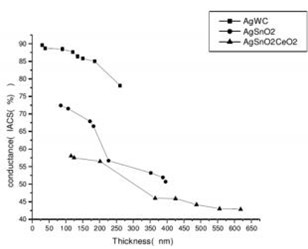
Fig. 2 Relationship between contact pressure and spot temperature rise
Ⅱ. CONCLUSION
In summary, the contact resistance of
electrical contact material is influenced by many factors, which include a variety of forms. No matter what, the research on contact resistance aims to improve the contact quality and evaluate its reliability through the failure mechanism. Their purpose is to find out the effective evidence from the different angles of theory, experiment, micro, statistics, material, and so on. At present, with the rapid development of power electronics technology, contact electrical equipment is still the most important system component. According to statistics, the annual output of the world relay is close to 4 billion, not to mention the penetration into the national economy and all aspects of life, such as switches, sockets, and other connectors. Therefore, it is very important to reduce the contact resistance and improve the reliability of electrical contact, which is very important to improve the quality of electrical contact products.