Posted on 8/25/2026 by Fudar Offical | Views: 197
When a circuit breaker interrupts a severe fault, an intense electrical arc forms between the separating contacts. The contact material must withstand the resulting heat and mechanical stress while resisting erosion, cracking, welding, and material loss—and it must continue to conduct reliably after the interruption.
Silver-tungsten carbide (AgWC) helps meet these competing demands. Silver provides high electrical and thermal conductivity, while tungsten carbide (WC) improves resistance to arc erosion. However, increasing the WC content or using finer WC particles creates a manufacturing trade-off: the powder becomes more difficult to compact into a stable, dense compact.
To address this challenge, Fudar Alloy developed a patented preparation method that forms a controlled pure-silver shell around individual WC particles. After coating, the powder is pressed, sintered, and infiltrated with additional silver. This core-shell approach is designed to improve powder formability and support the production of dense AgWC contact materials.
During compaction, loose powder is pressed into a temporary shape known as a green compact. Silver can deform permanently under pressure, allowing neighboring particles to conform and interlock. WC behaves differently. Because it is extremely hard, it changes shape very little under normal compaction pressures.
Where uncoated WC particles touch, their surfaces do not readily flatten or form strong mechanical bonds. As the WC content increases and the particle size decreases, these direct contacts become more frequent. The result can be weak regions, cracks, or a compact that does not hold its shape after pressing.
Conventional chemical coating methods may not fully solve the problem. If WC particles clump together during the coating reaction, silver may be deposited around an entire cluster rather than around each particle. Direct WC-to-WC contacts can therefore remain inside the cluster. The challenge is not simply to add silver, but to place it at the interfaces between individual WC particles.
Fudar Alloy's patented method creates a core-shell powder in which each WC particle is surrounded by a 10-200 nm pure-silver layer. This ductile coating physically separates neighboring WC particles and places deformable silver at the points where the hard particles meet.
During pressing, the WC cores remain rigid, while the silver shells deform and conform to adjacent particles. This reduces direct WC-to-WC contact, promotes mechanical interlocking through the silver layers, and helps form a more stable green compact. The effect is particularly important when fine WC particles or a high WC content would otherwise create many hard-to-hard contacts.
In simple terms, the method first forms a thin silver coating around the WC particles. The coated powder is then blended, pressed, sintered, and infiltrated with additional silver to produce a dense AgWC contact material.
Together, these stages improve powder formability and densification. The silver coating supports more effective compaction, while subsequent silver infiltration fills residual pores and helps form a dense AgWC structure.
| Parameter | Patent-defined range |
| Average WC particle size | 0.5-8 micrometers |
| Pure-silver shell thickness | 10-200 nm |
| WC content in the final material | 40-90 wt.% |
| WC powder-to-silver nitrate solution ratio | 5-70 g/L |
| pH after sodium hydroxide addition | 8-9 |
| PEG molecular weight | 500-20,000 |
| PEG addition | 7-12% of the WC powder mass |
| Glucose solution concentration | 30-300 g/L |
| Green compact porosity | 5-55% |
These ranges define the method's processing window rather than a universal specification for every AgWC application. Specific parameters should be selected according to the material composition and manufacturing requirements.
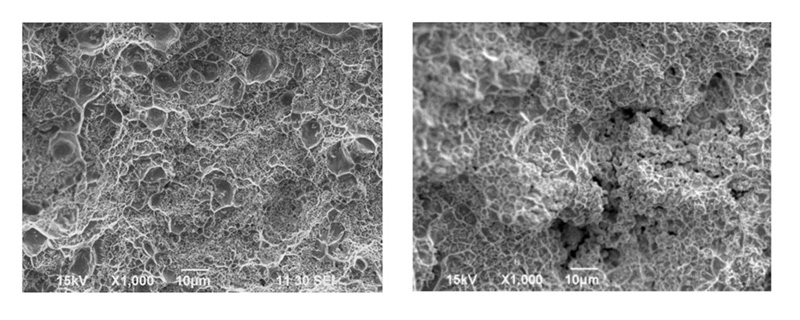
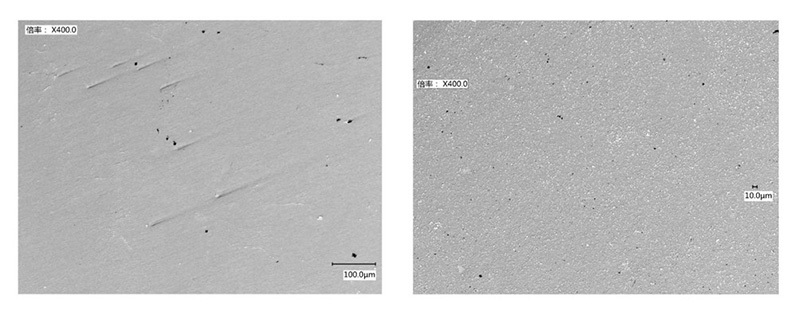
The supporting images include scanning electron microscope (SEM) images comparing an AgWC material produced using this preparation method with a commercially available reference material. In the areas shown, the material produced using this method exhibits good bonding between the silver and WC phases, with no obvious microporosity, while the reference sample contains a visibly porous region. Metallographic images from two preparation examples provide additional views of the resulting AgWC microstructures.
Together with the results from the preparation examples, these observations are consistent with the method's intended outcome: a dense AgWC microstructure with good bonding between the silver and WC phases. This is important because pores and poorly consolidated regions can disrupt conductive paths, concentrate thermal and mechanical stresses, and create potential sites for localized erosion or material loss.
Microstructure is only one factor influencing contact performance. Breaking capacity and electrical life also depend on contact geometry, contact force, opening speed, arc-control design, attachment quality, and operating conditions. Application-specific electrical testing therefore remains essential.
The method demonstrates how engineering the surface of individual WC particles can help address a bulk manufacturing challenge. By surrounding rigid WC particles with a thin, ductile silver layer, the process improves their behavior during pressing while retaining the hard WC phase required in the finished contact material. Sintering and subsequent silver infiltration then help form a dense, well-consolidated AgWC structure.
For equipment manufacturers, this approach provides a processing route for balancing conductivity, arc-erosion resistance, mechanical integrity, and manufacturability.
Backed by more than 260 granted patents, Fudar Alloy develops electrical contact materials and solutions for demanding switching applications.
Looking for an AgWC solution for high-breaking-capacity equipment? Contact our team to discuss your application requirements.
Please fill out the form below. Our sales team is ready to assist you with any questions or inquiries.