I. INTRODUCTION
Among all kinds of metals, pure silver has fine electrical conductivity, heat capacity, excellent machining performance and low contact resistance, so it is widely used as substrate material for electrical contact materials. However, pure silver is soft, easy to fusion welding and has material transfer tendency. To circumvent these shortcomings many studies on silver matrix composites with high mechanical property have been done. AgNi is a main kind of electric contact material which has low contact resistance, good processing performance, good anti-erosion ability and non-toxic etc, but low welding resistance. Since July 1, 2006, the European Union began to implement RoHs 2002/95 / EC and WEEE2002/96 / EC to restrict Pd, Hg, Cd, etc. from application, which promotes AgNi to one of the research focus of electrical contact materials.
To circumvent low welding resistance of AgNi materials domestic and foreign scholars have done a lot of researches on the influence of Ni content. The research by Y. L. Deng, X. W. Huang et al showed that the Ni content plays an important role. When it is too high the contact resistance increases and the electrical conductivity decrease, whereas welding resistance decrease obviously, but they didn’t provide concrete data of Ni content. Q. F. Luo et al prepared AgNi10 and AgNi30 by mechanical alloying, and analyzed its microstructure, but they didn’t analyze the influence on welding resistance. Based on the above reasons, this article introduces using the
powder metallurgy extruding and drawing technology to manufacture AgNi
electrical contact materials with different Ni content. It also studied on both microstructure and electrical performance which can provide theoretical guidance for the choice of AgNi electrical contact materials in future.
II. EXPERIMENT
We selected Ag powders with more than 99.9% purity and 10μm average particle size, Ni powders with more than 99.9% purity and 3μm average particle size. We used a BS124S analytical balance with precision of 0.0001 to weight powders. We respectively fixed Ag powders and different content Ni powders in 1-3h then made the mixed AgNi powders into compacts using Φ90 isostatic pressing machine. We put the compacts in sintering furnace under 700-800℃ in H_2 in 1-3h. Extruded the compacts into Φ6mm wires under 750-850℃. Wires were processed by drawing → annealing(300-400℃,0.5- 2h) → drawing then were made into Φ1.38mm products. We used VTA532 Vickers hardness tester, TH2512B intelligent DC low resistance tester, L150 metallurgical microscopy and JSM-6390A SEM for material testing. We made these wires into rivets with specification of F:4×1+ 2×2(0.4) and R:4 ×1+2×2(0.4) R20. We took flat surface rivets as stationary contact, curved surface rivets as movable contact. We test these
rivets with electric performance testing machine which was developed both by my company and Xi’an Jiaotong University. Voltage was set to AC 220V, current was 20A, duty cycle was 36%, contact pressure was 100g, piecewise frequency was 40 times/min, contact distance was 2mm, test times was 100000 times and the load was AC load.
III. RESULTS AND DISCUSSION
A. Influence of Ni Content on the Microstructure of AgNi Materials
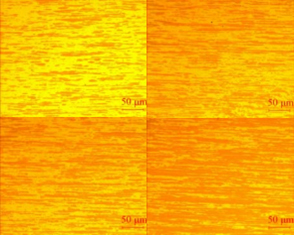
Fig.1 shows the metallograph of AgNi wires with different Ni content (longitudinal section). We can see the wires showed uniformly distributed microstructure and the Ni particles showed filamentary morphology. Ni particles were stretched under the action of tensile stress. As the increasing of Ni content filamentary morphology became more obvious.
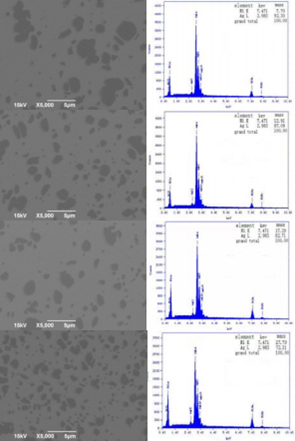
Fig.2 shows the back scattering EDS pictures of AgNi materials with different Ni content (cross section). We can see that the particle size of Ni was decreasing with the increase of Ni content, because the relative shifting resistance in Ag matrix was decreasing with the increase of Ni content, Ni phases moved from dense area to sparse area and their dispersion degree became more highly in Ag matrix. Meanwhile in the EDS pictures the mass ratio of Ag and Ni were 92.30: 7.70, 87.09: 12.91, 82.71: 17.29 and 72.21: 27.79, the numbers were the same as powder mixed moment.
Fig. 1. Microstructures of AgNi materials with different Ni content (longitudinal section)
(a)10% (b)15% (c)20% (d)30%
Fig. 2. Back scattering EDS pictures of AgNi materials with different Ni content (cross section)
(a)10% (b)15% (c)20% (d)30%
B. Influence of Ni Content on Relative Density of AgNi materials
Table 1 shows measured density, theoretical density and relative density of AgNi materials with different Ni content. We can see that relative density was increasing with the increase of Ni content, this because the dispersed Ni phase have grain refining influence on Ag matrix. As the increase of Ni content the grain size of Ag decreased, grain-boundary increased. That produced more passageways for the escape of gases and for the diffusion of Ni to Ag. Reduced the diffusion activation energy of Ni, speeded up the densification process and increased relative density of AgNi materials. When the grain-boundary increased extruded and drawn AgNi materials became stickier that caused the densification process quicker.
TABLE I. DENSITIES OF AGNI MATERIALS WITH VARIOUS NI CONTENT
| Ni content % |
Measured density g/cm3 |
Theoretical density g/cm3 |
Relative density % |
| 10 |
10.23 |
10.31 |
99.2 |
| 15 |
10.16 |
10.22 |
99.4 |
| 20 |
10.09 |
10.14 |
99.5 |
| 30 |
9.95 |
9.96 |
99.9 |
C. Influence of Ni content on Resistivity and Hardness of AgNi materials
Fig.3 shows resistivity and hardness of AgNi materials with different Ni content. We can see that resistivity and hardness increased with the increase of Ni content. Each AgNi components cannot be combined to solid solution, so AgNi is a kind of heterogeneous alloy. Being heterogeneous alloy, the main effect factors on electrical conductivity are volume ratio and dispersion degree of composition phases. Compared with Ag Ni has weaker electrical conductivity, so with the increase of Ni content volume ratio of Ni to Ag increased and resistivity of AgNi increased. In the same time the composition phases were more disperse, the dispersed probability of the electron on the crystal boundary was higher and resistivity was higher too. Based on the two factors, resistivity of AgNi increased with the increase of Ni content. Volume ratio and dispersion degree of composition phases made deciding influence on hardness too. Ni is harder than Ag, with the increase of Ni content volume ratio of Ni to Ag increased and hardness of AgNi increased. Within certain limits the particle size of composition phases was smaller, the dispersed strengthening effect was more obvious and hardness was higher.
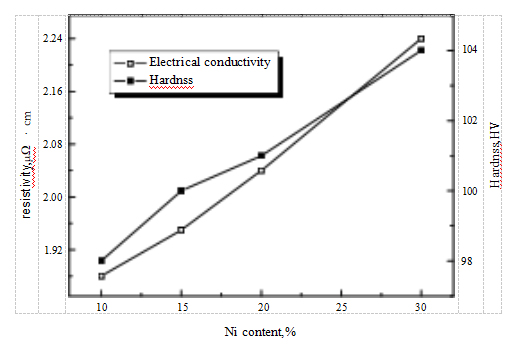
Fig. 3. Influence of Ni content on resistivity and hardness of AgNi materials.
Fig.4 shows the influence of different Ni content on the welding force of AgNi materials. We can see that AgNi15 had smallest welding force, this because there are dual influences on AgNi welding resistance performance. On the one hand, when Ni content was increasing there need higher temperature and longer time to make Ni melted into Ag matrix, when it was congealed Ni oxides gathered in the surface of electrical contact, so when the Ni content is higher the welding resistance performance is better. On the other hand, with the increase of Ni content hardness and tensile strength increased but welding force increased. The two factors restricted each other, when Ni content was less than 15% the gathering of Ni oxide influenced the welding force most. The welding force of AgNi15 is less than AgNi10. When Ni content was more than 15% tensile strength influenced the welding force most. The welding force of AgNi30, AgNi20 and AgNi15 gradually increased. Meanwhile the welding force of AgNi15 is 5g which is less than the data in other literature. The welding resistance performance of AgNi electrical contact materials was improved.
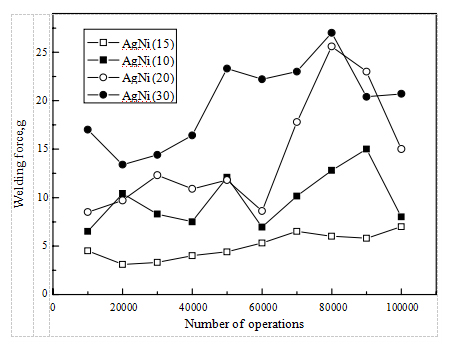
Fig. 4. Influence of Ni content on the welding force of AgNi materials
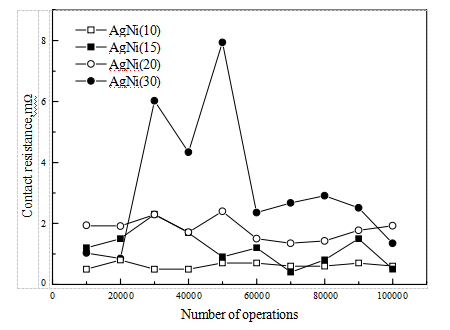
Fig.5 shows the influence of different Ni content on the contact resistance. We can see that the contact resistance of AgNi increased with the increase of Ni content. This because when AgNi was congealed Ni oxides gathered in the surface of electrical contact which made the surface contact resistance increased. The higher of Ni content made the bigger surface contact resistance. AgNi10 has minimum value and AgNi30 has maximum value.
Fig. 5. Influence of Ni content on the contact resistance
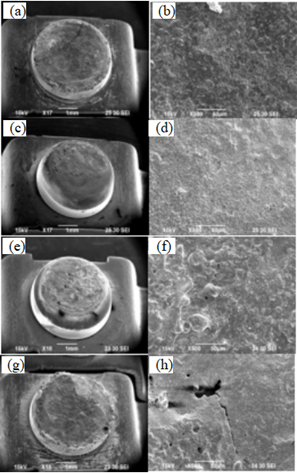
Fig.6 showed the influence of different Ni content on the arc erosion morphology. From Fig.6 (a), (c), (e) and (g) we can see the burning area of AgNi15 was smallest, this because Ni content has dual influences on the arc erosion of AgNi materials. On the one hand, Ni particles usually distributed in Ag matrix as very tiny dispersed phase which led the arc erosion decrease, the higher Ni content was the smaller burning area was. On the other hand, the increase of Ni content led contact resistance increase and temperature rose led burning area increased. The two factors restricted each other, when Ni content less than 15% the dispersed Ni phase influenced the burning most. The burning area of AgNi15 is smaller than AgNi10. When Ni content was more than 15% contact resistance influenced the burning most. The burning area of AgNi30, AgNi20 and AgNi15 successively increased.
From Fig.6 (b), (f) and (h) we can see that the burning areas of AgNi10, AgNi20 and AgNi30 came up rapid phase transition under the action of arc and mechanical force. This made the surface of contact terminal appeared a lot of dispersed little etch pits, concave-convex marks and traces which were made in liquid metal form and splash process. Otherwise, because of temperature gradient and eddy current effect there were rotational flow traces and color changes of molten material in the surface of contact terminal. From Fig.6 (b) we can see that in the surface of contact terminal have no obvious flowing and radiating traces and the burning area is stable together and no drift of backflow traces.
Fig. 6. The arc erosion morphology of AgNi materials with different Ni content (movable contact)
(a)(b)10% (c)(d)15% (e)(f)20% (g)(h)30%
IV. CONCLUSION
- Using powder metallurgy extruding and drawing technology in preparation of AgNi electrical contact materials with different Ni content. Ni particles showed filamentary morphology and its dispersion degree became more highly with the increase of Ni content.
- Ni content has single influence on relative density, hardness, resistivity and contact resistance of AgNi materials: with the increase of Ni content they all increased.
- Ni content has dual influences on the welding force and the arc erosion of AgNi materials: the welding force and the arc erosion of AgNi15 are smallest, AgNi10 is bigger, AgNi30 is biggest.