1. INTRODUCTION
The safety and reliability of power relays play a crucial role in electrical equipment. When a power relay operates under sealed, capacitive, and inductive conditions, the arc energy caused by the current is very high, and the heat is not easily transmitted. This can easily cause contact melting during early service, leading to relay failure, and in severe cases, it may cause fire or other serious consequences. Therefore, studying the resistance to fusion welding of electrical contact materials was of great significance.
In the
electrical contact material industry, engineers have also conducted research on contact materials for power relays. With the increase of Cu element content in AgSnO2 materials, the microstructure gradually changes from short whisker-like oxides to slender fibrous-like structures. However, when the Cu content exceeds 6.8%, there was a phenomenon of "dissolution segregation" inside the organization, where a large amount of oxide particles aggregate at grain boundaries and the size of the microstructure increases. Some scholars point out that as the arc root density increases, the arc energy also increases, leading to larger and deeper erosion craters in the SnO2 aggregation area. As mentioned earlier, a large number of arcs are concentrated in the same area, resulting in a rapid increase in temperature in that area and an inability to dissipate for a long time. Due to the relatively low melting point of Ag(961℃), the Ag particles near the agglomeration zone melt to form a molten pool, resulting in a large number of Ag droplets splashing under the combined action of arc heat and force.
In the actual use of sealed power relays, welding problems caused by contact bonding often occur. This article aims to provide useful references for the development of electrical contact materials for power relays by studying the simulated electrical performance parameters between materials with different oxide contents, including arc time, arc energy, welding force, and contact surface morphology characteristics after testing.
2. TEST PROCESS AND METHODS
The alloy internal oxidation method was one of the commonly used methods for producing silver tin oxide electrical contact materials. The materials prepared by this process have good resistance to burning loss and fusion welding, and have wide applications in the products of various relay manufacturers in China.
This article uses the alloy internal oxidation method to prepare three materials and compares the properties of the two materials. The specific components are shown in Table 1. Then, the three materials were made into
rivet-shaped contacts, and electrical performance tests were conducted on a simulated electrical performance testing machine. The three contact points were assembled into power relays, and electrical life tests were conducted.
Table 1. Comparison of Material Composition
| Category |
Component(wt.%) |
Notes |
| Ag |
SnO2 |
Additives |
| 1# |
90 |
Remain |
1 |
- |
| 2# |
86 |
Remain |
1 |
- |
| 3# |
84 |
Remain |
1 |
- |
The production process of sample materials in this study was as follows: the raw materials were melted and then hot extruded to produce AgSn alloy, which was then subjected to alloy drawing, alloy cutting, oil removal treatment, internal oxidation, ingot pressing, sintering, AgSnO2 hot extrusion, and finished product drawing to prepare the required specifications of wire φ1.92 [Soft state]. The microstructure of AgSnO2 was analyzed using SEM scanning electron microscopy; density was measured using the drainage method; hardness was measured using a MICROHARDNESS MHV2000 hardness tester; tensile strength and elongation were measured using a LJ-1000 material testing machine; and electrical resistance was measured using a TH2512B intelligent DC resistance tester and converted into electrical resistivity.
Use a rivet machine to cold upset the wire obtained from the above steps to a specification of R4×0.79+2×0.55 rivet contacts, and then conduct simulated electrical performance tests. At the same time, the simulated electrical performance equipment was tested using a contact material electrical life simulation testing machine developed in cooperation with domestic universities. The simulated electrical performance testing device is shown in the following Figure 1, mainly including an XYZ three-axis displacement sliding table, a driving mechanism composed of a direct-acting electromagnet and a push rod, an electromagnet travel limit mechanism, and a relay base group. The system could adjust the action point of the push rod by adjusting the Z-axis and Y-axis displacement sliding tables, and adjust the X-axis displacement sliding table control limit block of the electromagnetic travel limit mechanism, thereby adjusting the idle and overtravel of the push rod. The position adjustment accuracy is both 10μm. The device could conveniently replace the contact spring systems of different relays for simulation testing, and could synchronously measure contact voltage, current, and welding force. Table 2 shows the simulated electrical performance test conditions.
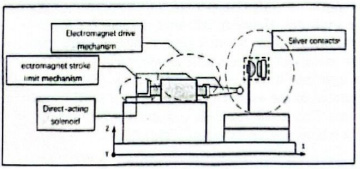
Figure 1. New Simulated Electrical Performance Test Device
Table 2. Simulated electrical performance test conditions
| Category |
AC voltage |
AC |
Opening and closing frequency |
Load type |
Notes |
| Simulated electrical performance testing conditions |
250VAC |
15A |
1s, on |
Resistive load |
- |
| 1s, off |
- |
| Electrical life test conditions |
16A |
5s, on |
- |
| 5s, off |
- |
3. TEST RESULTS AND ANALYSIS
Firstly, the mechanical and physical properties of materials with different oxide contents were compared. The specific data were shown in Table 3. It could be seen that material 1# has the lowest electrical resistivity, with a density about 0.06g/cm3 higher than material 2#. The elongation was the highest among the three materials, reaching 29%.
Table 3. Physical performance comparison
| Category |
Tensile strength(MPa) |
Elongation rate(%) |
Resistivity (μΩ.cm) |
Density(g/cm3) |
Hardness |
| 1# |
341 |
29 |
2.29 |
9.86 |
103 |
| 2# |
344 |
24 |
2.41 |
9.80 |
110 |
| 3# |
340 |
20 |
2.65 |
9.82 |
105 |
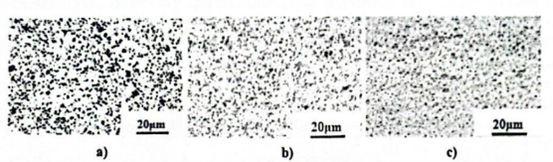
Figure 2 shows the microstructure of materials with different oxide contents. From the SEM scanning electron microscope photos, it could be seen that the oxide particles were uniformly distributed in the silver matrix, and the oxide particle sizes of the three materials were similar, with most particles in the range of 1μm. According to theoretical research in materials science, adding a second phase component to a metal could strengthen the base metal. The principle was to use dispersed particle structures to hinder the movement of dislocations, thereby enhancing the mechanical and physical properties of the base material. So in this experiment, with the increase of oxide content, the hardness, tensile strength, and other parameters of the material were improved, but the elongation of the material showed the opposite pattern.
Figure 2. Comparison of microstructure of materials with different oxide contents
a) 1#Material, b) 2#Material, c) 3#Material
The electrical performance comparison of the three materials is shown in Tables 4 and 5. Within the 95% confidence interval, the electrical life of the three materials with different oxide contents was 39342, 89314, and 29345 times, respectively. The average electrical life of material 2# was about 62000 times higher than that of material 1#. From Table 5, it could be seen that in actual relay electrical life testing, the material with 2#content has achieved a test result of about 94000 electrical lives within the 95% confidence interval.
From the above data, it could be seen that when the oxide content reaches a certain proportion, the prepared electrical contact material exhibits good electrical life test results. The three materials exhibit the same electrical life pattern as the simulation testing machine in actual testing, so the next step was to use the data captured from the simulation electrical performance test to compare the differences between the three materials.
Table 4. Comparison of simulated electrical performance test data
| Category |
1 |
2 |
3 |
4 |
5 |
ρ0.95 |
| 1# |
45265 |
46859 |
39685 |
44586 |
42598 |
39342 |
| 2# |
99865 |
102562 |
100000 |
114785 |
102156 |
89314 |
| 3# |
32562 |
41205 |
39568 |
34785 |
33568 |
29345 |
Table 5. Comparison of Relay Electrical Life Test data
| Category |
1 |
2 |
3 |
4 |
5 |
ρ0.95 |
| 1# |
33026 |
28965 |
30254 |
29856 |
32564 |
26073 |
| 2# |
102564 |
112563 |
105989 |
103654 |
100000 |
94426 |
| 3# |
20356 |
25468 |
30215 |
31025 |
26874 |
20293 |
To clarify the detailed reasons for the different electrical performance of three materials with different oxide contents in simulation testing, machine testing, and actual relay testing, and to understand the characteristics of arc erosion of electrical contact materials during service, this article selected materials with different oxide contents in simulation electrical performance testing results of 39685 times, 100000 times, and 39568 times. The results showed the arc energy, arc time, and welding force of four surface morphology parameters after the contact test.
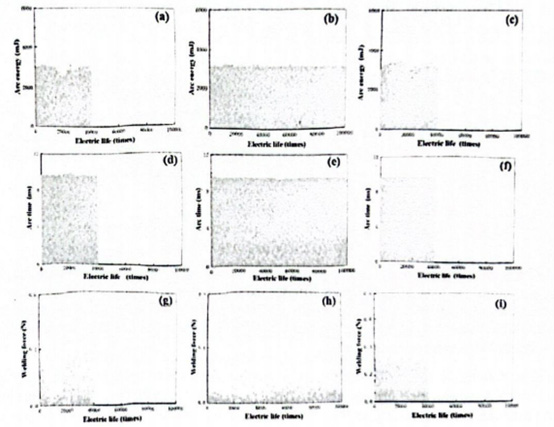
Figure 3 shows the comparison of arc energy, arc time, and welding force of materials with different oxide contents in the simulated electrical performance test. It could be seen from the figure that under the same current level conditions, the peak arc energy of 1#content material was about 3000mJ, 2#content material was 3100mJ, 3#content material is 3500mJ, and 3# content material was the highest, reaching 10ms, The fusion welding force of material with 1#content was the highest, which was because as the oxide content of the material increases, the material resistivity also increases, and the heat generated during the test process also increases, ultimately manifested as different arc energy and arc time.
Figure 3. Comparison of simulated electrical performance, arc energy, arc time, and welding force
(a)1#material Are energy; (b)2#material Arc energy; (c)3#material Are energy; (d)1#material Arc time; (e)2#material Are time; (f)3#material Arc time; (g)1#material welding force; (h)2#material welding force; (i)3#material welding force
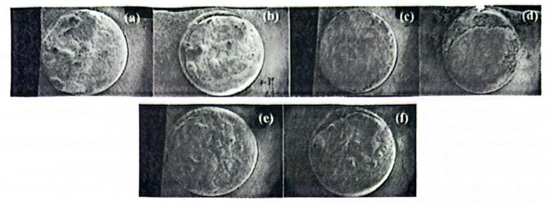
Figure 4 shows the surface morphology of the contacts after arc burning in the simulated electrical performance test. It could be seen from Figure 4 that the surface of the moving point of the 2#content material contact was relatively flat after the contact test. In addition, the surfaces of the other two materials show obvious burning pits and adhesive silver spots after the moving contact test. At the same time, there was a certain area of collapse at the contact edge, which affects the electrical performance of the contacts.
Figure 4. Comparison of contact surface morphology after simulated electrical performance test
(a)moving contact of 1#material, 39685 failure; (b)static contact of 1#material, 39685 failure;
(c)moving contact of 2#material, 100000 failure; (d)static contact of 2#material, 100000 failure;
(e)moving contact of 3#material, 39568 failures; (f)static contact of 3#material, 39568 failures.
From the above research comparison, it could be seen that when the oxide content of silver tin oxide electrical contact material was 14%, its various physical properties were relatively excellent. During service, due to its high-melting-point components and high hardness, under the action of load current, the contact's resistance to melting and electrical wear was superior to the other two materials. 1#material exhibits poor arc wear resistance due to its low proportion of high-melting-point component oxides. However, when the oxide content increases to 16%, due to the excessive content of the second-phase component, the electrical resistivity of the material was significantly increased. During the test, it exhibits poor anti-bonding performance, affecting the conductivity of the contacts and ultimately causing bonding failure.
Based on the above experimental results, improving the electrical wear resistance and adhesion resistance of contact materials in power relays was one of the main topics for improving the electrical life of materials. At the same time, considering different types of load conditions and relay structures, further research was needed to adjust the proportion of additives to improve the material's breaking performance and resistance to fusion welding.
4. CONCLUSION
(1) With the increase of oxide content, the tensile strength and resistivity of the material have significantly increased, while the elongation shows a decreasing trend.
(2) The 95% confidence interval of the Weibull curve indicates that when the oxide content is 14%, the silver tin oxide electrical contact material exhibits the best electrical lifetime on the testing machine, approximately 89000 times.
(3) In power relay testing, when the resistivity of the material is relatively high, the temperature rise of the contacts is large, which is prone to early contact bonding and resulting in failure.
(4) When designing materials, it is necessary to consider the actual testing conditions and usage scenarios of the electrical appliance, and select appropriate silver-content electrical contact materials for adaptation.