Among them, AgCdO(15)
contact material has become a commonly used material in railway signal relays due to its excellent performance. So, what are the unique features of this material? How does the manufacturingprocess affect the performance?
Why Choose AgCdO(15) Contact Material?
AgCdO(15) contact material is a silver-based metal oxide containing 15% cadmium oxide (CdO). This material combines the high electrical conductivity of silver with the high hardness and arc burn resistance of CdO, allowing it to excel in high-frequency on-off operations. Unlike pure silver or simpler silver alloys, which might suffer from excessive welding or rapid material transfer under the high currents and frequent switching cycles found in railway signal relays, AgCdO(15) offers a unique balance of properties for unparalleled reliability. Its key advantages include:
1.Excellent resistance to fusion welding: It is not easy to stick under high current and arc environments, which ensures long-term stable operation of the relay.
2.Low contact resistance: Maintains good electrical conductivity even after prolonged use.
3.Strong abrasion resistance: Adapt to the use of frequent on and off scenarios to extend the life of the equipment.
Influence of manufacturing process on the properties of AgCdO(15) contacts
The properties of AgCdO(15) materials depend greatly on their manufacturing process. The study compares the common internal oxidation method with the multiple extrusion process and finds that the latter significantly improves the material properties.
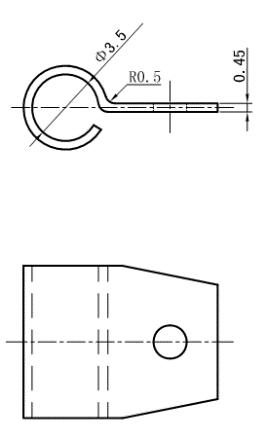 Description of AX Series Relay Contacts
Dynamic contacts have a ring-like opening with a diameter of 3.5 mm, at the end of which the structure is slightly curved with a bend radius of 0.5 mm. The thickness of the contact is 0.45 mm, which is suitable for precision relay components. The contact ends in a slightly converging trapezoidal design with a round hole in the centre, which can be used for mounting or connecting other components. The trapezoidal shape is distinctive, wider at the bottom and slightly narrower at the top, with smooth transitions at the edges.
1.Internal oxidation method
Principle: Generate CdO particles inside the material through the reaction between oxidant and cadmium in silver-based alloy.
Advantage: Simple process, suitable for mass production.
Disadvantage: The material has poor plasticity and is prone to cracks or breakage under high deformation demand scenarios.
2.Multi-extrusion process
Principle: The material undergoes multiple extrusions. This process makes the internal structure denser and helps evenly distribute the CdO particles.
Advantages:
lImproved material plasticity: Suitable for the manufacture of complex shaped contacts.
lMore stable performance: Better electrical conductivity and resistance to soldering than materials prepared by internal oxidation.

New Process Horizontal 200X

New Process Vertical 200X
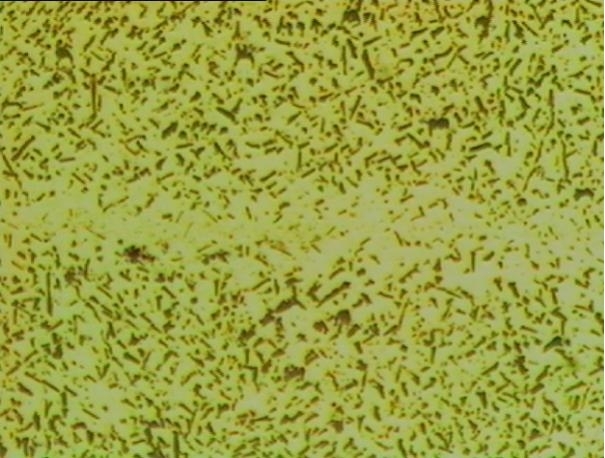
General Internal Oxidation ProcessHorizontal 200X
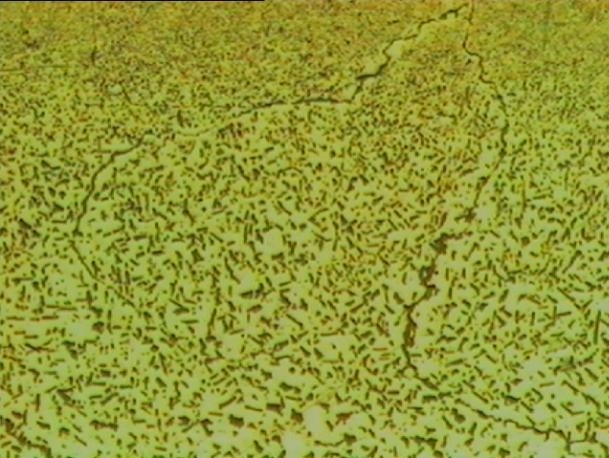
Common Internal Oxidation Process Vertical 200X
Experimental Data: Under the hard state conditions, the tensile strength and elongation of the common internal oxidation process and the new process do not differ much; under the annealed state conditions, the tensile strength of the AgCdO15 material prepared by the new process is slightly higher than that of the common internal oxidation process, and the elongation reaches 28%, which has good strength and plasticity.
The resistivity of the AgCdO15 material prepared by the new process is lower than that of the common internal oxidation process. This is due to the fact that the material prepared by the new process has no grain boundaries and the oxide distribution is more uniform.
|
Tensile Strength(MPa)
|
Elongation(%)
|
Hard State
|
Annealed State
|
Hard State
|
Annealed State
|
Common Internal Oxidation Process
|
373
|
233
|
3
|
16
|
New Process
|
356
|
264
|
3
|
28
|
|
Resistivity(μΩ·cm)
|
Common Internal Oxidation Process
|
2.56
|
New Process
|
2.33
|
Application and Practical Effect
Studies show that using AgCdO(15) contacts in railway signal relays has improved equipment reliability. These contacts are made using a multiple extrusion process. Under experimental conditions of DC 24V/1A, the service life of the contact exceeds 2 million on-off operations, which significantly extends the maintenance cycle of the relay.
Future Perspective
AgCdO(15) contact materials work very well in railway signal relays. However, the use of CdO has decreased due to new environmental rules. In the future, environmentally friendly materials such as silver-based tin oxide (AgSnO₂) are expected to gradually replace AgCdO.
AgCdO(15) contact materials still provide the best balance of performance and reliability. This makes them ideal for use in the current railway transport sector.
By optimizing the process and exploring new materials, the contact performance of railway signal relays will improve. This will provide a solid guarantee for the safe operation of the railway system. For more information about the AgCdO and related solutions or products, please visit
https://www.fudarworld.com/ or feel free to contact us.