Posted on 10/10/2026 by Fudar Offical | Views: 8
Silver-based electrical contacts are key components in low-voltage switching devices used in building power distribution, household appliances and control systems, where contact performance affects reliability and service life.
Silver zinc oxide (AgZnO) contact materials combine silver's electrical and thermal conductivity with dispersed zinc oxide particles that help resist arc erosion and contact welding. ZnO content and particle size influence the balance between conductivity, mechanical strength and switching performance.
This article compares three AgZnO materials under AC resistive loads to show how these factors affect arc behavior, welding force and erosion resistance.
Samples 1 and 2 have the same ZnO particle size range but different oxide contents. Samples 2 and 3 have the same oxide content but different particle size ranges.
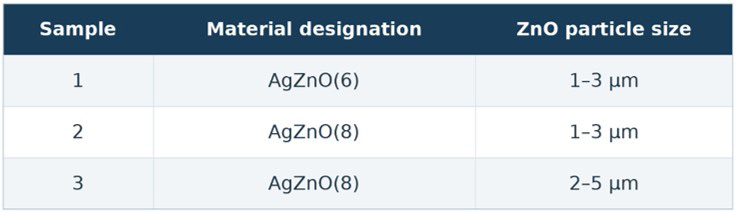
Table 1. AgZnO material designations and ZnO particle size ranges.
The materials were produced using a powder pre-oxidation process, then extruded into silver alloy wire and formed into contact rivets.
The contacts were tested at AC 250 V and 10 A with a resistive load, a static contact force of 1.5 N and a contact gap of 0.5 mm. Each switching cycle consisted of 1 second on and 1 second off. Contact erosion was measured after 100,000 cycles.
With ZnO particles in the 1-3 μm range, AgZnO(8) had higher hardness, tensile strength and bulk resistivity than AgZnO(6). Bulk resistivity describes how strongly the material opposes current flow.
The higher ZnO content increased the number of particles dispersed in the silver matrix, although a greater tendency for particle clustering was also observed. Particle reinforcement and refinement of the silver grains help explain the higher hardness and tensile strength. Additional interfaces also impede electron transport, increasing bulk resistivity.
Under the AC resistive test conditions, AgZnO(8) showed longer arc duration, greater arc energy and higher welding force. Higher resistivity may increase local heating and enlarge the molten region at the contact interface, requiring greater separation force after solidification.
At the same AgZnO(8) composition, increasing the ZnO particle size range from 1-3 μm to 2-5 μm reduced hardness, tensile strength and bulk resistivity. Microscopic examination also showed a coarser structure and a reduced tendency for particle clustering.
Coarser particles provide less interfacial area, reducing their strengthening effect and electron scattering. Under the same test conditions, the coarser-particle material showed lower welding force, but longer arc duration and greater arc energy. The lower welding force may reflect reduced local heating associated with its lower bulk resistivity.
After 100,000 switching cycles, AgZnO(8) with 1-3 μm ZnO particles had the lowest erosion loss at 0.5 mg. The corresponding losses were 0.8 mg for AgZnO(6) at the same particle size and 1.3 mg for AgZnO(8) with 2-5 μm particles. Under these test conditions, erosion loss increased as ZnO content decreased or particle size increased.
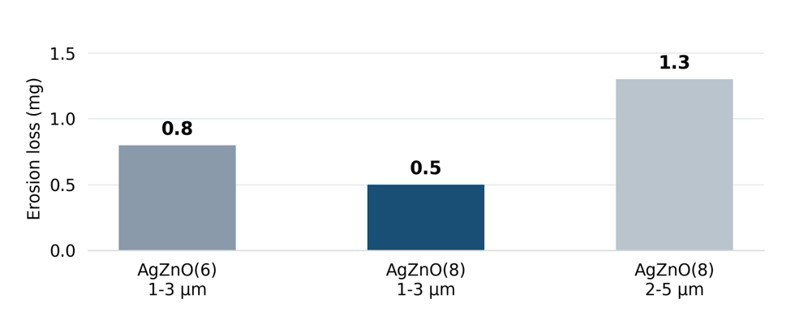
Figure 1. AgZnO contact erosion loss after 100,000 switching cycles.
Under the tested resistive conditions, AgZnO(8) with 1-3 μm ZnO particles offered a favorable overall balance and the lowest erosion loss among the three materials. AgZnO(6) at the same particle size produced shorter arcs and lower arc energy. Increasing the particle size of AgZnO(8) to 2-5 μm reduced welding force but increased erosion loss.
Higher ZnO content increased hardness, tensile strength and bulk resistivity, while coarser particles reduced these properties. Final material selection should balance mechanical strength, conductivity and switching performance, with suitability confirmed through testing in the intended device.
To discuss AgZnO material selection for your application, feel free to contact Fudar Alloy.
Please fill out the form below. Our sales team is ready to assist you with any questions or inquiries.