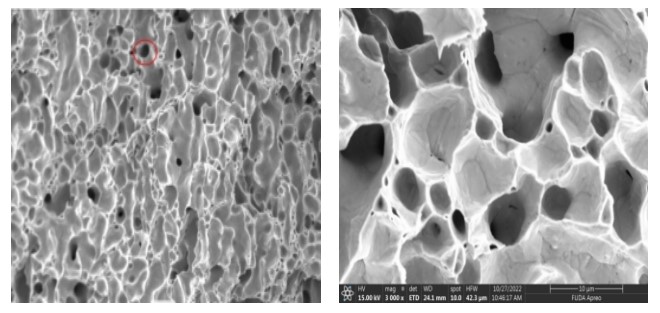
During the production process, porosity in the solder layer is a common issue. This often leads to a decrease in the solder brazing rate and negatively impacts product performance. Fudar Alloy's researchers have proposed targeted improvement strategies by studying the causes of porosity formation.
What is Extruded Silver Graphite Contact Material?
Extruded silver graphite contact materials are made using a vertical fiber-reinforced structure. The process involves powder mixing, isostatic pressing, sintering, and extrusion. Graphite provides resistance to fusion welding, while silver offers excellent electrical conductivity. This combination makes the material suitable for static contacts, meeting the demands of high-intensity current switching.
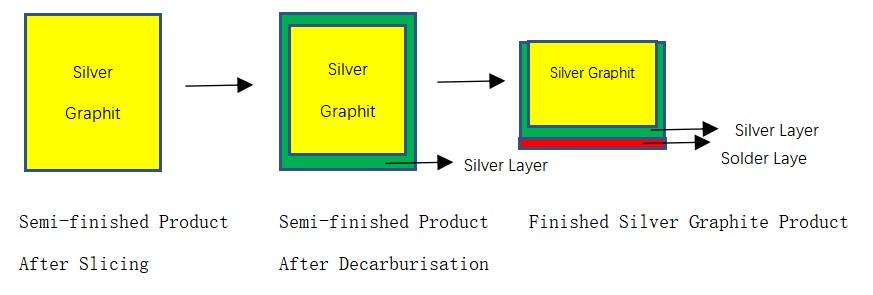
The contacts are back-coated with a solder layer to achieve more efficient soldering performance. Due to porosity created by the decarburization process during machining, the solder layer often develops pores during welding. This is caused by gas expansion and negatively affects the strength of the weld.
Causes of Porosity in the Solder Layer
Research shows that the porosity mainly comes from the following two processes:
1. Decarbonisation process: Graphite oxidized to carbon dioxide escapes at high temperatures, forming dense and small pores. After decarburization, the pores in the silver layer align with the distribution of the original graphite particles. This directly leads to the problem of porosity in the solder layer.
2. Soldering process: After the solder melts, the gas in the decarburized silver layer expands and escapes. Some of this gas is trapped by the solder layer, which eventually cools and solidifies, forming pores.
Pores in the Silver layer
Innovative Solutions to Improve Porosity Problems
To solve the solder layer porosity problem, the study proposed the following improvement strategies:
Add the sintering process after decarburisation.
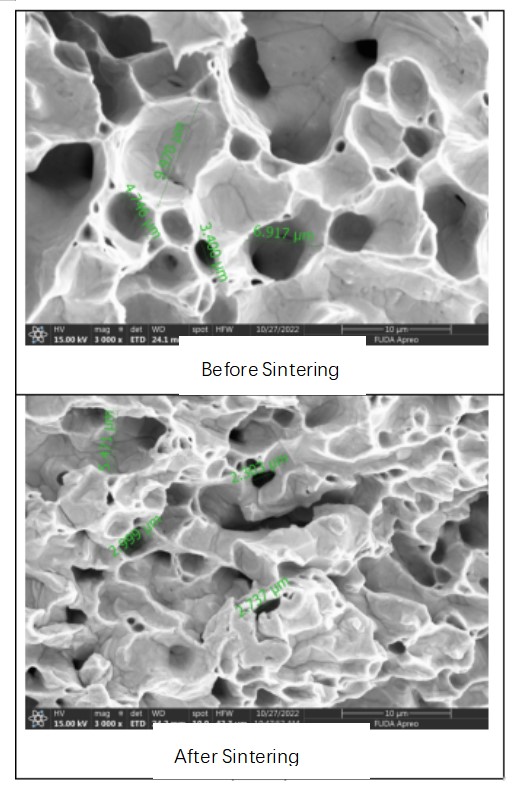
Mechanism: The sintering process helps shrink the pores further. This reduces the amount of gas released during the soldering process.
Validation results: At a sintering temperature of 600~700°C, the size of the pores in the decarburized silver layer is significantly reduced, and the number of pores in the solder layer is reduced.
Adjust the decarburisation process.
Strategy: Increase decarburization thickness or adjust decarburization rate and temperature.
Validated results: Increasing the thickness of the decarburized layer did not significantly improve the porosity problem in the solder layer. However, optimizing the decarburization rate and temperature helped reduce the porosity density.
Experimental Results and Analysis
1. Effect of sintering temperature
600~700℃: The size of the pores in the decarburized silver layer is significantly reduced. As a result, the pores in the solder layer are also reduced, with a smaller pore size.
700 ~ 800 ℃ and above: The size of the decarburized silver layer expands, and the number of pores is reduced, but the improvement is not significant. This affects the precision of the material's shape.
Size Change of Decarburisation After Sintering
| Plan |
Sintering Temperature/℃ |
Size After Decarburisation |
Size After Sintering |
Results |
| 1 |
600~700 |
9.95x9.95 |
9.95x9.95 |
OK |
| 2 |
700~800 |
9.95x9.95 |
9.99x10.01 |
NG |
| 3 |
800~900 |
9.95x9.95 |
10.05x10.07 |
NG |
Effect of decarburisation thickness
Increasing the thickness or optimizing the decarburization rate can improve the number of porosities in the solder layer. However, this improvement is limited. Further optimization is needed along with the next sintering process.
Practical Application Effect
The optimized extruded silver graphite
contact material shows a higher brazing rate and reliability during soldering. Controlling the sintering temperature between 600 and 700°C has effectively reduced the porosity of the solder layer. This improvement has enhanced the shear strength and extended the product life after soldering.
Conclusion and Perspective
By adding a sintering process after decarburization and optimizing temperature control, significant progress has been made in addressing the porosity issue in the solder layer of the extruded silver graphite contact materials. Future research can focus on further optimizing the decarburization process and sintering parameters together. This will provide additional technical support for the development of high-performance electrical contact materials. For more information about the extruded silver graphite contact materials, please feel free to contact us.