Posted on 9/17/2026 by Fudar Offical | Views: 129
Molded-case circuit breakers (MCCBs) are widely used in industrial facilities and buildings to protect electrical circuits and equipment against overloads and short circuits. Their contacts must carry and interrupt current reliably while withstanding the effects of arcing.
Silver-zinc oxide (AgZnO10) is widely used as an electrical contact material in circuit breakers because it resists contact welding and arc erosion. However, composition is only part of the story. Powder preparation can influence material density, particle bonding, and electrical resistivity—all of which affect the physical properties of the finished contact.
To improve AgZnO10 powder-metallurgy (PM) contact tips for circuit breaker applications, Fudar Alloy compared three production routes: conventional mechanical powder mixing, untreated pre-oxidized powder, and pre-oxidized powder followed by an additional treatment step. This treatment targeted a key problem in the untreated powder: a ZnO-rich layer around silver particles that hindered compaction and sintering.
Mechanical powder mixing is commonly used for higher-current contacts, but it can produce localized ZnO agglomeration and relatively low density. Internal oxidation of finished contacts offers a simpler, lower-cost route, but it may result in a coarser microstructure and higher resistivity. Pre-oxidizing atomized AgZn powder can improve oxide dispersion, but pressing the powder directly creates another challenge.
During oxidation, zinc may migrate to the particle surface and form a ZnO-rich shell around the silver particles. This shell reduces metal-to-metal contact, making the powder more difficult to compact and contributing to higher resistivity.
Fudar Alloy evaluated an additional powder-treatment step by comparing 50 × 10 × 2 mm specimens produced through the three routes. SEM and metallographic analysis were used to examine the powder surfaces, fracture morphology, and internal ZnO distribution. Density, resistivity, and HV0.3 microhardness were then measured.
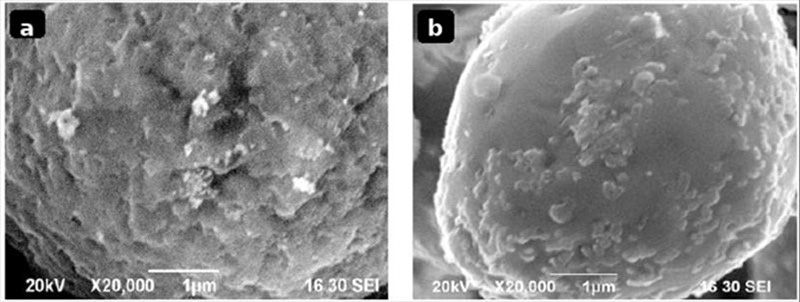
SEM images revealed a clear change in the powder surface. The untreated pre-oxidized powder had a rough, uneven surface. After the additional treatment, much of the surface layer was removed, leaving the particles smoother.
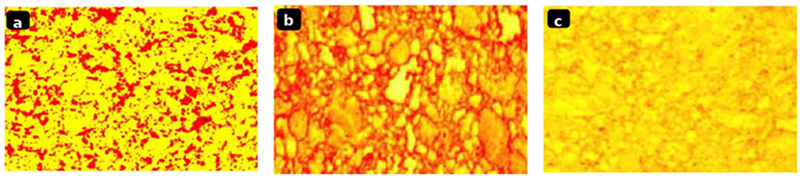
Metallographic images showed corresponding changes within the pressed specimens. Samples produced by mechanical mixing contained localized ZnO agglomerates, while those made from untreated pre-oxidized powder showed ZnO-rich layers around some silver particles. After treatment, these layers were broken up, and the ZnO particles were finer and more evenly dispersed within the silver matrix.
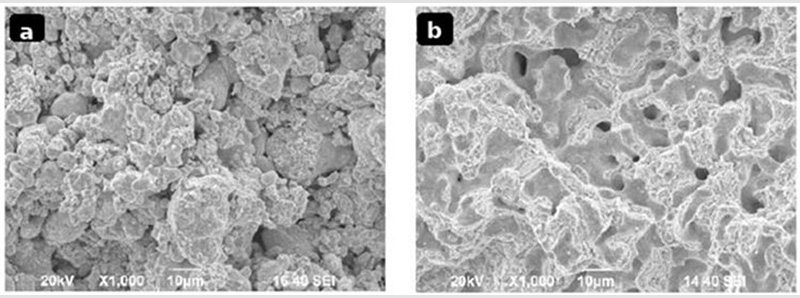
During sintering, the pressed powder is heated so neighboring particles can bond without fully melting. In the untreated specimen, the ZnO-rich surface layer limited contact between silver particles, leaving the fracture surface loose and particulate. After treatment, the fracture surface appeared more continuous, suggesting improved metallurgical bonding within the silver matrix.
The treated pre-oxidized powder showed higher hardness and density and lower resistivity than the untreated powder.
Table 1. Physical properties by production route| Production route | Hardness (HV0.3) | Density (g/cm³) | Resistivity (µΩ·cm) |
| Treated pre-oxidized powder | 90-105 | 9.55-9.70 | 2.35-2.70 |
| Mechanical powder mixing | 75-85 | 9.40-9.55 | 2.30-2.60 |
| Untreated pre-oxidized powder | 85-100 | 9.35-9.45 | 3.50-4.00 |
| Chinese National standard (PM) | ≥74 | ≥9.55 | ≤3.40 |
| Chinese National standard (IO) | ≥66 | ≥9.40 | ≤2.70 |
Lower resistivity means less opposition to current flow, while higher density generally indicates fewer pores and more complete particle bonding. The untreated pre-oxidized material did not meet the cited PM limits for density or resistivity. After treatment, its hardness, density, and resistivity all met the listed PM requirements. Compared with mechanical mixing, the treated material showed higher hardness and density, while its resistivity remained within a similarly low range.
The results indicate that controlling the ZnO-rich surface layer can make pre-oxidized powder more suitable for PM contact tips used in circuit breaker applications. Compared with untreated pre-oxidized powder, the additional treatment produced a finer, more uniform ZnO distribution and improved the measured physical properties.
These findings apply to the materials and processing conditions evaluated. Switching endurance was not tested, so application-specific electrical validation is still required under the intended load and operating conditions.
Fudar Alloy develops PM contact tips for circuit breaker applications, with support covering material selection, contact design, manufacturing, and application validation. Explore our PM contact tip solutions or contact our team to discuss your requirements.
Please fill out the form below. Our sales team is ready to assist you with any questions or inquiries.