However, relay contacts must operate under demanding electrical conditions. When switching resistive loads such as automotive lamps, the inrush current can reach 5 to 10 times the rated current, increasing the risk of contact welding. When switching inductive loads such as motors, the arc duration becomes longer and more difficult to extinguish, which leads to severe erosion of the contact surface. These effects directly reduce contact reliability, shorten electrical life, and may ultimately affect the safety and stability of the entire vehicle system.
Therefore, improving the arc-erosion resistance of
electrical contact materials remains a key topic in automotive relay development. Among widely used contact materials, AgSnO₂ (silver tin oxide) has attracted significant attention for its strong resistance to welding and material transfer. To further enhance its performance, researchers have investigated the effect of adding indium (In) to AgSnO₂ and evaluated how different indium levels influence contact behavior under relay operating conditions.
Research Objective
This study was designed to examine how different indium contents—1.5%, 3.5%, and 5.5%—affect the performance of AgSnO₂ contact materials in automotive relay applications.
By comparing key performance indicators such as mass loss, arc energy, welding force, and surface morphology, the study aimed to identify a suitable indium content range and provide a reference for the optimization of relay contact materials.
Test Method
To simulate real automotive relay operating conditions as closely as possible, AgSnO₂ wires with different indium contents were prepared using the internal oxidation method and then processed into rivet-type contacts.
The tests were carried out on an electrical contact performance simulation platform capable of reproducing contact movement and collecting real-time data, including arc energy, arc duration, and welding force. Test parameters were set according to the operating conditions of a representative automotive relay.
Mass loss was calculated by comparing the contact weight before and after testing. In addition, scanning electron microscopy (SEM) was used to analyze the eroded contact surfaces and evaluate microstructural changes after repeated operation.
Key Results
The results showed that indium content has a clear and measurable influence on the arc-erosion performance of AgSnO₂ contacts.
1. Lower Mass Loss with Higher Indium Content
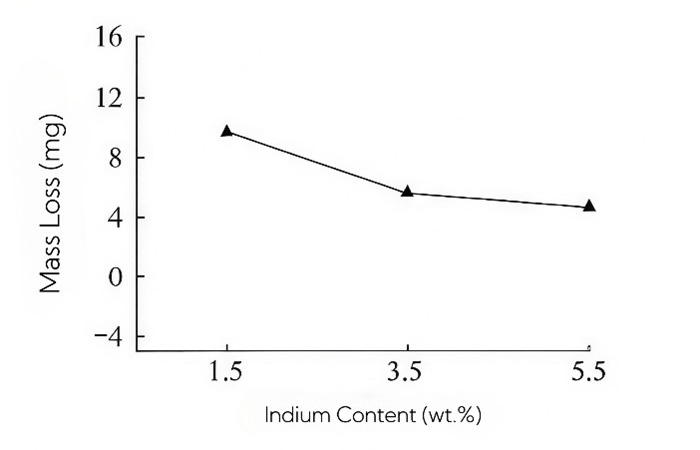
As the indium content increased, the contact mass loss gradually decreased.
This is mainly because high-melting-point In₂O₃ increases the viscosity of the molten pool. As a result, liquid silver becomes less likely to splash away from the contact surface, reducing material loss.
At 5.5% indium, the contacts showed the lowest mass loss. Surface splashes were mainly fine particles rather than large spherical droplets, indicating stronger resistance to arc erosion.
2. Arc Energy Behavior Depends on Indium Level
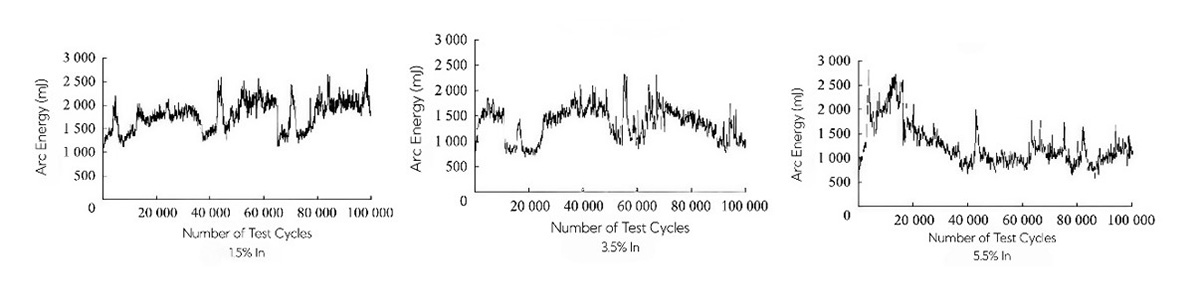
When the indium content was 1.5% or 3.5%, arc energy gradually became stable as the number of switching cycles increased, suggesting relatively steady contact behavior.
At 5.5% indium, however, arc energy first increased, then decreased, and finally stabilized. This trend is likely related to the higher hardness of the contact material at higher indium levels. Increased hardness can reduce the initial contact area and make contact bounce more likely, which raises arc energy in the early stage of operation.
As switching continues, the contact surface becomes more even due to arc erosion, the effective contact area improves, and arc energy gradually stabilizes. This indicates that while higher indium content benefits erosion resistance, excessive levels may affect switching stability in the initial stage.
3. Higher Indium Content Improves Anti-Welding Performance
Welding force is a key indicator of the tendency of contacts to stick together during operation.
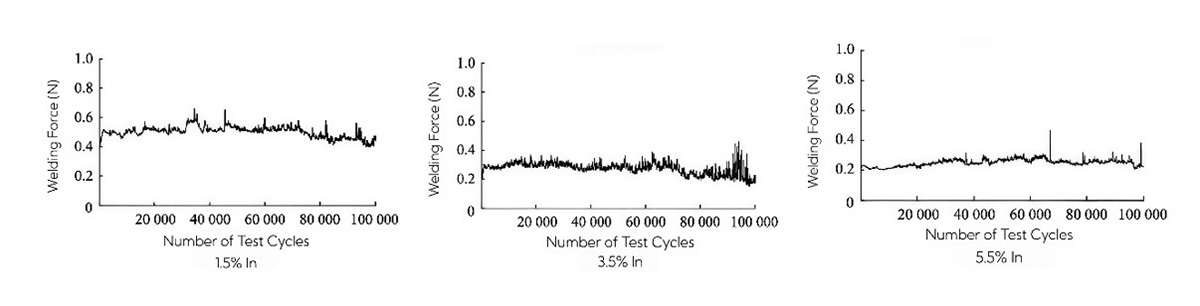
The study showed that the welding force was highest at 1.5% indium, reaching about 0.5 N. As the indium content increased, the welding force decreased significantly, dropping to around 0.2 N at 5.5%.
This result indicates that higher indium content can markedly improve anti-welding performance. One reason is that In₂O₃ separates more easily from molten silver, which reduces bonding strength at the contact interface and lowers the risk of welding.
A notable observation was made at 3.5% indium: after 90,000 electrical cycles, the welding force increased again to nearly 0.4 N. Since the break-force threshold of automotive relays is around 0.4 N, this suggests that under long-term operation, a 3.5% indium level may still present a certain welding risk.
4. Surface Morphology Confirms Performance Differences
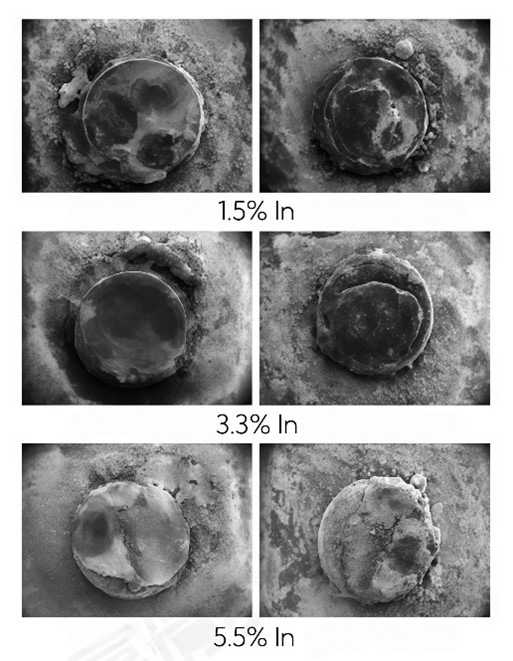
SEM analysis further revealed clear differences in erosion morphology.
At 1.5% indium, the contact surface showed extensive melting and a large number of coarse splashes, indicating more severe arc erosion.
At 5.5% indium, the eroded surface showed more dispersed molten areas and finer droplets. Although metal sputtering still occurred, the increased viscosity of the molten pool helped reduce overall material loss. These microstructural changes were directly reflected in the macroscopic electrical performance of the contacts.
Conclusion
Based on the combined analysis of mass loss, arc energy, welding force, and surface morphology, several conclusions can be drawn:
- Increasing indium content helps reduce splashing and material loss, improving resistance to arc erosion.
- Higher indium content also lowers welding force and enhances anti-welding performance.
- Excessively high indium content may increase initial contact bounce and temporarily raise arc energy.
- For automotive relay applications, considering electrical performance, relay break-force requirements, and cost control, the recommended indium content range is 3.5% to 5.5%.
Looking Ahead
As automotive electrical systems continue to evolve, relay contacts must deliver higher reliability and longer electrical life. This study provides a useful reference for optimizing AgSnO₂ contact materials, showing that appropriate indium content can help balance anti-welding performance, arc stability, and material loss.
At
Fudar Alloy, we remain committed to the continuous innovation and optimization of electrical contact materials, delivering reliable, high-performance solutions for the electrical and electronics industry.