And how does the powder particle sizeaffect the organisation and properties of the material during its preparation? Researchers from
Fudar Alloy have studied the effect of different particle sizes of AgSn alloy powder on the pre-oxidation microstructure. Their findings provide a scientific basis for the development of new electrical contact materials.
Why is Particle Size So Important?
AgSnO₂ materials are usually prepared by powder pre-oxidation. This method is effective in improving resistance to fusion welding and wear. However, the powder particle size can significantly affect the oxidation reaction:
1. Small particle size: The oxidation reaction is concentrated around the particles. As a result, the oxide layer is thin and homogeneous.
2. Large particle size: The thickness of the oxide layer increases. However, oxide agglomerates tend to form, leading to uneven properties.
To study this phenomenon in depth, three types of AgSn alloy powders with particle sizes of 15 μm, 116 μm, and 264 μm were selected for the experiment. Their microstructures and properties after pre-oxidation were then systematically analyzed.
Research Methodology and Experimental Design
Material Preparation
Three types of AgSn alloy powders with different particle sizes were prepared using the atomization process. All powders have the same chemical composition: 91% Ag and 8% Sn.
Pre-oxidation: The powders were held at different temperatures (400-900°C) to form an oxide layer.
Performance testing: After pre-oxidation, the powders were tested for properties such as hardness, elongation, and electrical resistivity. This testing was done through isostatic pressure molding, sintering, and extrusion.
Table 1 Paricle Size and Composition of Test Materials
| Material |
Average Particle Size (μm) |
Ingredient Content (wt%) |
| Ag |
Sn |
Additives |
| Atomised Powder |
15 |
91 |
8 |
Balance |
| 116 |
| 264 |
Core Finding: Particle Size Affects Microstructure and Properties
Effect of different particle sizes on the microstructure of pre-oxidation
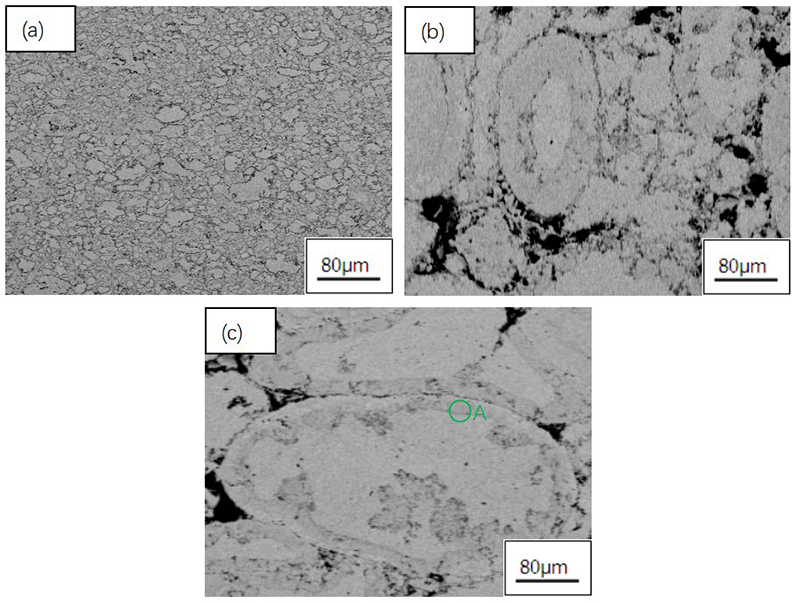
Small particle size (15 μm): Oxidation mainly occurs at the edges of the particles. The oxide layer is thin and uniform.
Medium particle size (116μm): The thickness of the oxide layer increases significantly, reaching about 20 μm. A dense oxide layer forms at the edge of the particles.
Large particle size (264μm): The oxide aggregation phenomenon is evident. The thickness of the oxide layer does not increase further. Local oxides diffuse selectively along the grain boundaries, forming agglomerated areas.
Fig.1 Pre-oxidation Microstructure of Different Particle Size of Atomized Powders (Backscattered Scanning Electron Microscope Photos)
(a) 15μm, (b) 116μm, (c) 264μm
When the powder particle size is 15 μm, oxidation mainly occurs at the edge of the particles. As the particle size increases, an oxide layer forms around the particles. Further increasing the particle size does not increase the thickness of the oxide layer and may even lead to the agglomeration of the oxide particles.
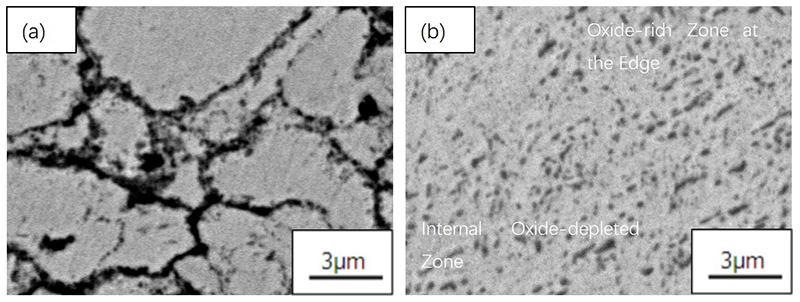
Meanwhile, the morphology of 15 and 264 μm atomised powder oxide particles was observed, as shown in Fig. 2. Figure 2(a) shows the organization of 15 μm powder after oxidation. The oxide size is around 0.2 μm.
Figure 2(b) shows an enlargement of region A in Figure 1(c). After oxidation of the 264 μm atomized powder, the particle size of the oxide in the oxide-enriched region at the edge is around 1 μm, in the form of elongated strips. This is significantly larger than the oxide particles in the interior of the particles, which are around 0.3 μm. Comparing Figure 2(a) and Figure 2(b), the oxide particles of the 15 μm powder are significantly smaller than those of the 264 μm powder after oxidation.
Fig.2 Pre-oxidation Microstructure of Different Particle Size of Atomized Powders
(Backscattered Scanning Electron Microscope Photos)
(a) 15μm, (b) 264μm
Effect of Different Particle Sizes on Post-extrusion Properties
To investigate the effect of different particle sizes on material properties and organization, the organization of the 116 μm and 264 μm powders after oxidation was found to be similar. Therefore, 15 μm and 264 μm atomized powders were selected. These powders were pre-oxidized, isostatically pressed to form the material, then sintered and extruded with an extrusion ratio of 190. The material properties of the 15 μm and 264 μm powders after extrusion are compared in Table 2.
- Hardness: The hardness of the 15 μm powder material was 102.1 HV. This was slightly higher than the hardness of the 264 μm powder, which was 100.8 HV.
- Elongation: The elongation of 15μm material (6%) was significantly higher than that of 264μm (3%).
- Electrical resistivity: Both are close to each other, 2.23 μΩ·cm and 2.26 μΩ·cm, respectively.
Table 2 Comparison ofthePerformanceAfter Extrusion
Particle Size of Atomised Powder
|
Hardness (HV)
|
Tensile Strength (MPa)
|
Elongation (%)
|
Electrical Resistivity (μΩ·cm)
|
| 15μm |
102.1 |
309.5 |
6 |
2.23 |
| 264μm |
100.8 |
309.7 |
3 |
2.26 |
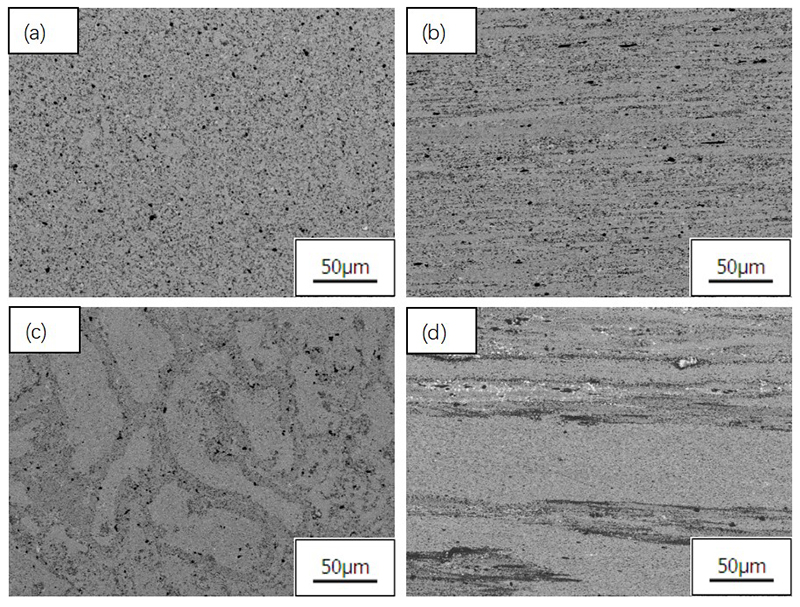
To deeply analyze why the hardness and elongation after extrusion of the 15 μm atomized powder are slightly higher than those of the 264 μm atomized powder, the microstructures of both sample groups after extrusion were compared. The comparison is shown in Figure 3.
As shown in the horizontal photographs, the distribution of oxide particles after extrusion of the 15 μm atomized powder is more uniform. In contrast, the oxide particles after extrusion of the 264 μm atomized powder exhibit a reticulate pattern, with areas rich in oxide and areas depleted of oxide.
As shown in the longitudinal photographs, the oxide distribution after extrusion of the 15 μm atomized powder is linear along the extrusion direction. It is also more uniform, with only a small number of oxide-depleted areas.
The oxide distribution of the 264 μm atomized powder after extrusion shows more severe agglomeration along the extrusion direction. It is also accompanied by a larger area of oxide-depleted regions.
Comparing the microstructures after extrusion of the 15 μm and 264 μm atomized powders, it was found that the oxide particles were more uniform in the 15 μm powder. In contrast, the 264 μm powder showed obvious oxide-rich and oxide-depleted regions. As a result, the hardness and elongation of the 15 μm powder after extrusion were slightly higher than those of the 264 μm powder.
Fig.3 Comparison of the Microstructure After Extrusion
(Backscattered Scanning Electron Microscope Photos)
(a)15μm, Cross-section, (b)15μm, Longitudinal section,(c)264μm, Cross-section,(d)264μm, Longitudinal section
Why is There Such a Discrepancy?
The oxidation reaction is usually divided into three phases:
1. Rapid reaction phase: The oxide layer is formed rapidly and its thickness increases with reaction time.
2. Stabilisation phase: The oxide layer prevents the diffusion of oxygen and the oxidation reaction slows down.
3. Rapid reaction restart:The oxide layer cracks or falls off and the reaction accelerates.
In this experiment, in the low and medium temperature oxidation phase, the oxidation mainly occurs at the particle interface. During the high-temperature oxidation phase, the gap between the interfaces of AgSn powder particles with a small particle size is very small. The dense oxide on the surface prevents oxygen from diffusing, keeping the oxidation in a stable phase. As a result, oxidation primarily occurs at the particle interfaces.
In the case of AgSn powder with a larger particle size, the gap between the powder interfaces is larger. After internal oxidation, there is significant volume expansion. The initially formed oxide film layer begins to loosen or crack. The oxide layer also contains alloy composition. As a result, the reaction enters a rapid phase, forming a noticeable oxide layer. Additionally, some oxide along the grain boundary shows preferential orientation and agglomeration.
Application Prospects and Optimisation Directions
1.Recommended Particle Size
Research shows that the 15 μm small particle size powder exhibits the best performance in terms of microstructure and mechanical properties. This makes it ideal for high-performance contact materials.
2. Process Improvement
To improve the oxide distribution in large particle size powders, you can optimize the oxidation parameters. You can also add dispersants to enhance the material properties.
Conclusion
By studying the effect of different particle sizes of AgSn alloy powders on the pre-oxidation microstructure, we found that selecting the right particle size improves the material's microstructure. This choice also significantly enhances its mechanical and electrical properties.
This finding is important for creating new eco-friendly electrical contact materials. It also guides the design of future contact materials. If you have any questions about AgSn alloy powder,please feel free to contact us.