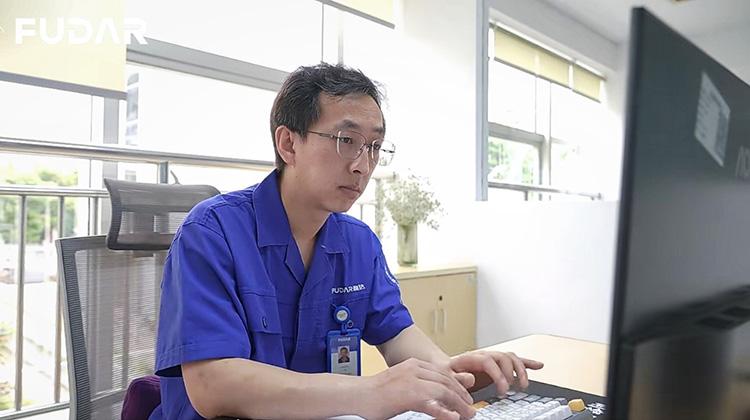
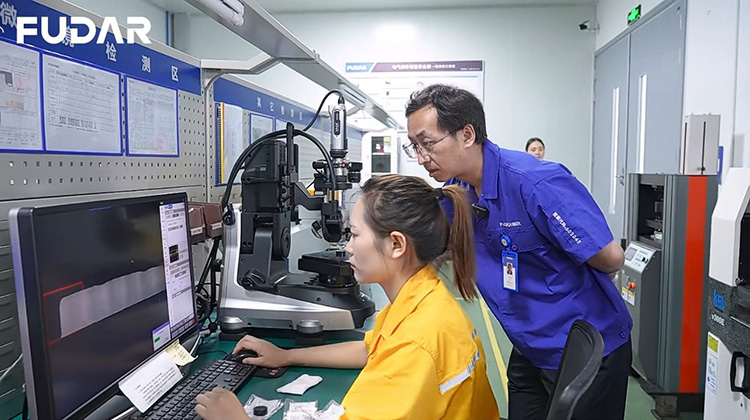
Wan Dai at work
Ask Wan Dai what has made his 23 years at Fudar worthwhile, and he points first to the trust he has built with customers.
Some long-standing customers turn to him for advice on difficult electrical contact problems, even when the product involved was not supplied by Fudar. To Wan Dai, their willingness to seek his perspective is one of the clearest signs that his work has created lasting value.
Learning by Doing
Wan Dai's career at
Fudar began in 2003, following the company's campus recruitment visit to Central South University. He joined shortly after graduating, alongside several classmates. Fudar was then based in Liushi, and working conditions were challenging, with power and water supplies not always reliable. The technical team was small, and experienced colleagues had heavy workloads, leaving little time for structured training.
His early development combined technical R&D with hands-on experience in production.
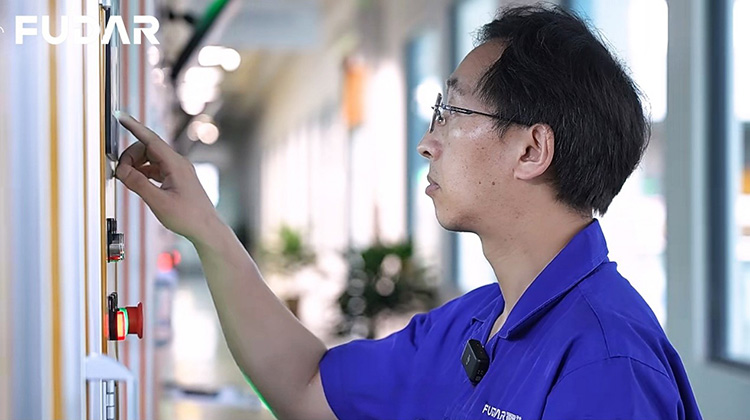
Wan Dai began his career at Fudar in a hands-on R&D role, working on silver contact tips and brazing alloys. During his first two years, he also completed rotations on the production floor, where he gained direct experience with internal oxidation and vacuum melting. Vacuum melting was especially demanding. He understood the basic operating procedure, but achieving consistently good results required a deeper understanding of how each stage affected the outcome. He built that understanding by observing the process, comparing results, and adjusting his approach.
Wan Dai on the production floor
His first invention patent marked an important early milestone in his career. Wan Dai led the development of the technology, with the application filed in 2005 and the patent granted in 2007. The achievement gave him greater confidence in his technical work and strengthened his commitment to
R&D and innovation.
That combination of R&D and production experience still shapes his approach. Even in a management role, he remains close to the production floor and emphasizes the collection and analysis of process data. As Fudar grew, upgraded its equipment, and served a broader customer base, his role expanded to include supporting customers during early-stage product development, analyzing electrical performance failures, helping shape broader technical priorities, coordinating projects, and developing his team.
Turning a Customer Problem into a Scalable Solution
One of the defining projects of Wan Dai's career began when an Italian customer turned to Fudar for a more reliable
electrical contact solution for a compact contactor. Because the device was smaller than a conventional contactor, it placed greater demands on its electrical contacts. The contacts the customer had been using were prone to contact welding, while excessive temperature rise was another concern.
The objective was clear: develop a contact material with greater resistance to contact welding while keeping temperature rise under control.
To meet this objective, Wan Dai and the technical team developed a new AgSnO₂ material system for
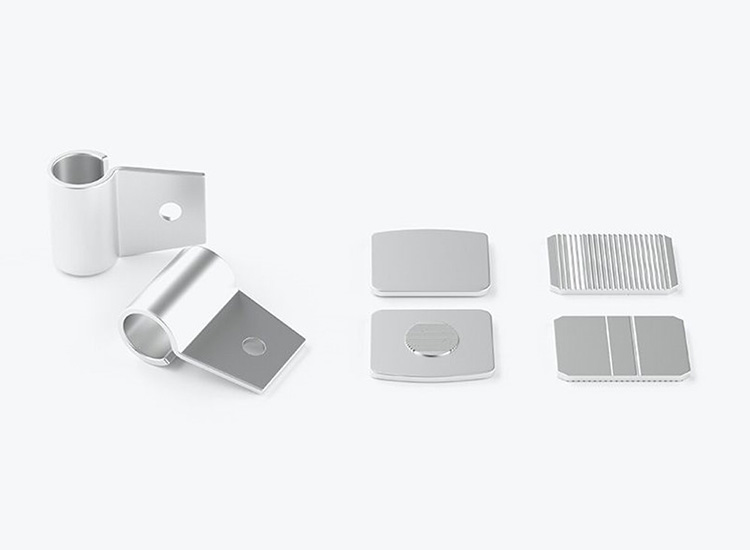
contact tips. The material design improved resistance to contact welding and helped reduce temperature rise, while process optimization lowered bulk resistivity. The team also developed an in-house contact performance evaluation system to assess candidate solutions before customer testing.
Fudar Alloy silver contact tips
Over the course of the project, Wan Dai and his team carried out hundreds of experiments, moving between the laboratory and the production floor to refine the structural design, evaluate materials, optimize performance, and validate the solution.
Because the customer was based in Italy, samples had to be shipped overseas for each round of testing, making the development cycle longer. The team therefore had to make every submission count, carefully reviewing and refining the solution before sending the next set of samples.
Once the solution had passed customer validation, the team faced a different challenge: moving from sample batches to stable volume production. Small batches could not reveal every issue that might emerge at scale. Early trials had established workable ranges for key process parameters, but volume production required tighter control. As production volumes increased, the team analyzed operating data and refined individual process steps until the process stabilized.
The AgSnO₂ contact material developed through the project continues to be produced and supplied today. It is used in specialized marine and
rail transit applications. Following the success of the original compact contactor project, Fudar introduced the solution to the Chinese market, where the same material system and related manufacturing processes have since been used for a broader range of customer projects.
Under Wan Dai's leadership, this R&D and industrialization work earned the Second Prize of the Zhejiang Provincial Science and Technology Progress Award in 2017.
For Fudar, the project did more than solve a problem for a single customer. It strengthened the company's capabilities in material design, performance evaluation, process optimization, and production scale-up. It also demonstrated that Fudar's capabilities in developing
application-specific contact solutions were comparable to those of established international suppliers of electrical contact materials.
When R&D Moves Beyond the Lab
For Wan Dai, the value of R&D becomes tangible when a new material moves beyond the laboratory and finds its place in a customer's product.
He has seen promising materials struggle to find the right application, while others have moved quickly into volume production by meeting a clear customer need. These contrasting outcomes have shaped how he thinks about technical success.
"As an engineer, seeing customers use a product I developed gives me a real sense of achievement", Wan Dai says. "If it never finds an application, then no matter how good it may be technically, it has not created real value".
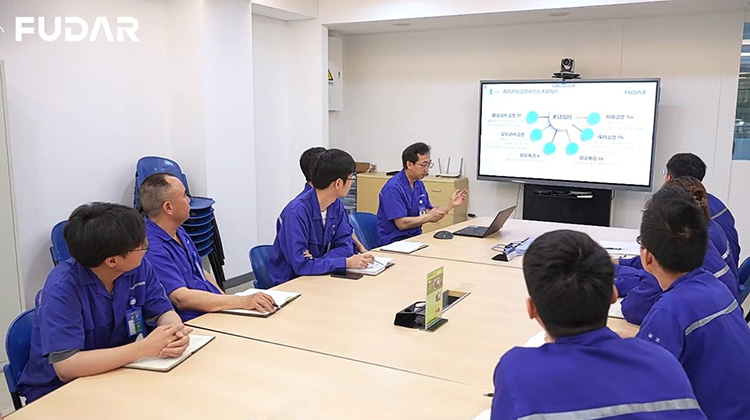
Wan Dai meeting with his technical team
For Wan Dai, customer relationships go beyond individual transactions. Working through technical problems gives both sides a chance to exchange ideas and learn from one another. When Fudar helps customers solve real problems, it earns their trust. When new challenges arise, they know they can turn to Fudar again.
Helping Engineers Find Their Own Answers
As Wan Dai moved into technical management, his role shifted from solving problems himself to helping others learn how to solve them. He could often reach an answer faster on his own, but building a capable team meant knowing when to step back.
"I usually let people try their own approach first", he says. "If there's something they haven't considered, I point them in that direction and ask them to think about how it might affect the result. Then we review the outcome together".
Wan Dai mentoring an engineer
For Wan Dai, the ability to innovate is what sets an excellent R&D engineer apart. Maintaining established processes and making incremental improvements both matter, but he believes engineers make their greatest contribution when they develop something new or take on technically demanding projects for key customers.
Over the years, engineers he has mentored have gone on to lead teams of their own or take ownership of technical projects.
Looking Ahead
Fudar's technical teams are focusing their R&D efforts on advanced materials and products in five areas: powder metallurgy contact materials, contact tips, contact rivets, profiled materials, and automotive contact materials.
Wan Dai's own focus is on advanced materials for contact tips, particularly expanding the use of AgSnO₂ materials in demanding product platforms for leading electrical equipment manufacturers.
His view of progress remains grounded in practical outcomes: a customer problem solved, a material performing reliably in volume production, and a younger engineer ready to take on greater responsibility.
For Wan Dai, that is what has made his 23 years at Fudar worthwhile.