Posted on 10/16/2026 by Fudar Offical | Views: 8
In EV charging connectors with a spring-loaded latch, spring force can make it difficult to align the latch and housing holes during assembly.
To simplify this assembly step, Fudar has developed a pin insertion fixture, shown in Figure 1, that positions the housing, holds the latch in alignment and drives the pin through both components. The fixture is designed to reduce manual effort and improve assembly efficiency.
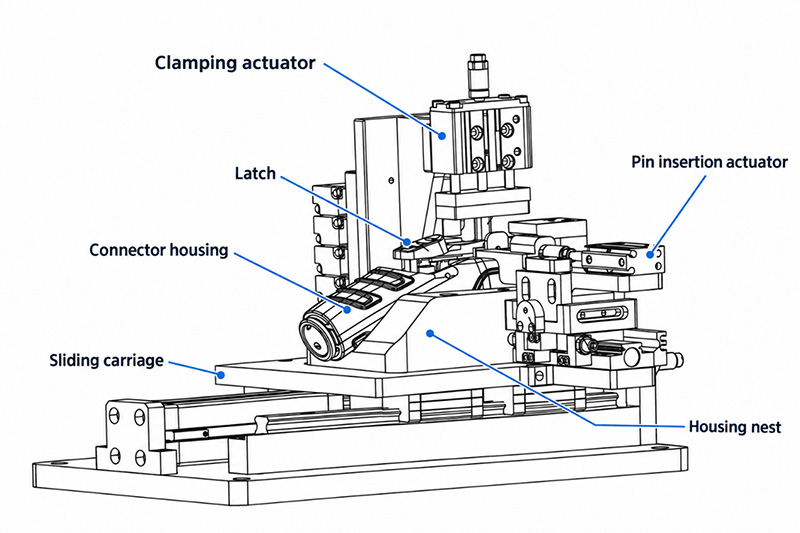
Figure 1. Overview of the pin insertion fixture
In this connector design, a spring sits inside the housing, beneath the latch. A pin joins the latch to the housing.
During manual assembly, the operator must do two things at once:
If the latch lifts or shifts before the pin passes through, the holes can move out of alignment. Holding the latch steady while inserting the pin takes sustained downward force and careful coordination, making it difficult to secure the latch reliably.
The fixture has a fixed base and a sliding carriage mounted on guide rails (Figure 1). A dedicated support, called the housing nest, is secured to the carriage. It locates the connector housing and keeps it steady during operation.
An actuator moves the carriage toward or away from the pin insertion unit. A sensor on the base detects when the carriage reaches its working position. This can be a pressure sensor that responds to contact with the carriage.
During setup, two adjustment blocks allow the pin holder to be moved vertically and horizontally. These adjustments align the insertion path with the holes in the latch and housing. A stop limits the travel of one of the blocks.
First, the hooked end of the latch engages a locating block attached to the carriage. As the carriage advances, the hooked end slides beneath an upper retaining block. The two blocks limit its vertical movement. A guide surface on the upper block helps the latch enter smoothly, reducing the risk of jamming or damage.
Even with the hooked end held in place, the spring can still lift the other end of the latch. Once the carriage reaches its working position, the clamping actuator lowers a clamping block onto the latch. This presses the latch down against the spring force. The latch pivots about its hooked end until its hole aligns with the housing holes and the pin. The block keeps the latch aligned during insertion.
Before insertion, the operator places a pin in the groove in the pin holder (Figure 2). The groove holds the pin in line with the latch and housing holes.
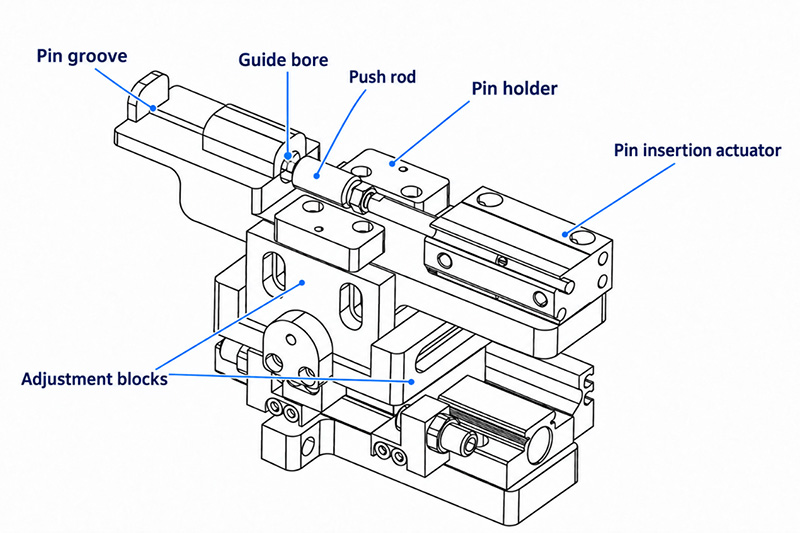
Figure 2. Pin insertion unit
With the latch held in alignment, the pin insertion actuator advances the push rod. A pusher fitted to the rod lines up with the groove and presses against the end of the pin, driving it through the latch and housing.
The push rod moves through a guide bore in the pin holder. This hole supports and guides the rod, helping limit sideways movement of the pusher during insertion.
Operators load the components manually, while actuators move the housing, clamp the latch and insert the pin. This removes the need to hold the latch down by hand while pushing the pin. Mechanical locating features also reduce reliance on manual alignment, helping simplify the operation and improve positioning consistency.
Explore Fudar's EV solutions, including electrical contact materials and precision-stamped components. Contact us to discuss your requirements.
Please fill out the form below. Our sales team is ready to assist you with any questions or inquiries.